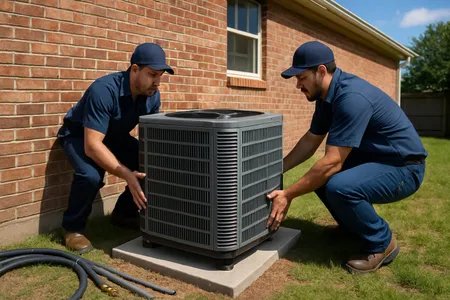
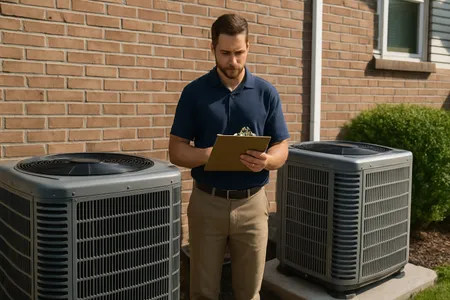
If you own a home between Killeen, Temple, and Waco, here is the short version of everything that follows: your HVAC system works an 8-9 month cooling season — one of the longest in the country — so problems surface earlier and maintenance matters more here than the national advice assumes. When something goes wrong, run five safe checks yourself (thermostat, filter, breakers, outdoor disconnect, drain line) before paying for a service call; treat gas smells, burning odors, and no-cooling-in-extreme-heat as emergencies and everything else as a business-hours appointment. When a repair quote exceeds half the cost of replacement, replace. And hire only TDLR-licensed, insured contractors who put equipment model numbers and scope in writing. The rest of this guide walks through each of those decisions in depth, with links to our detailed guides, cost breakdowns, and free tools at every step.
What this guide covers
- How do I know something is actually wrong with my HVAC system?
- Is it an emergency, or can it wait until morning?
- What can I safely check myself before calling anyone?
- Should I repair or replace my system?
- How do I choose an HVAC contractor in Central Texas?
- What does a fair HVAC quote look like?
- What does HVAC work cost in Central Texas?
- How does the Central Texas climate change the answers?
- What seasonal care does my system need here?
- What maintenance actually matters, and what does it cost?
- Which system should I choose when it is time to replace?
- Glossary: HVAC terms in plain English
- Frequently asked questions
How do I know something is actually wrong with my HVAC system?
Most HVAC failures announce themselves before they become breakdowns. The system still runs, but something is off: air that is moving but not cold, ice where ice should not be, water where water should not be, or a sound the unit never made before. Catching the symptom early usually means a smaller repair bill and, in a Central Texas summer, the difference between a scheduled visit and an emergency call.
Here is what the common symptoms usually mean, and where to go deeper:
| Symptom | What it usually means | Deep-dive guide |
|---|---|---|
| AC runs but the air is not cold | Dirty filter, low refrigerant, or a failing outdoor unit | AC not blowing cold air and our 12-cause troubleshooting guide |
| Water pooling by the indoor unit | Clogged condensate drain line, most often | AC leaking water inside |
| Ice on the refrigerant lines or coil | Airflow restriction or a refrigerant problem | AC unit freezing up |
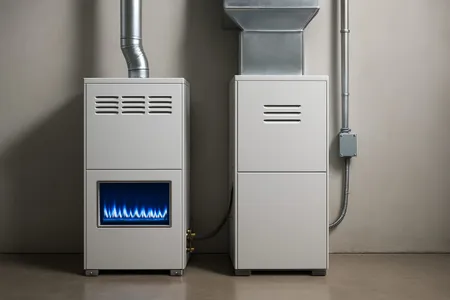
| Furnace will not start at all | Thermostat, power, or ignition issue | Furnace not turning on |
| Furnace runs but blows cold air | Pilot/ignition, flame sensor, or airflow issue | Furnace blowing cold air |
| Thermostat blank or unresponsive | Dead batteries, tripped breaker, or wiring | Thermostat not working |
| Error code on the unit or thermostat | Brand-specific fault code | Error code lookups by brand |
If the symptom does not fit the table, our free interactive troubleshooter walks you through a guided diagnosis step by step.
Two symptoms deserve special respect in our climate. Ice on an AC in July seems backwards, but a frozen coil means the system is being slowly damaged while it fails to cool — turn cooling off and let it thaw before running it again. And short cycling (the system starting and stopping every few minutes) is not a quirk; it is how oversized or struggling systems wear themselves out.
Is it an emergency, or can it wait until morning?
Five situations justify an emergency call. Almost everything else is a business-hours appointment, and treating it that way typically saves 50 to 100 percent on the bill.
Call for emergency help — or the right emergency service — now, if:
- You smell gas. Do not troubleshoot. Turn off the gas supply if you can do so safely, get everyone out of the building, and call your gas company first. HVAC comes after safety.
- You see sparking, arcing, or smell electrical burning. Shut the system off at the breaker and call for service.
- The AC is out during extreme heat and someone vulnerable is in the home — infants, elderly family members, or anyone medically fragile. Central Texas summers regularly exceed 100°F; this is a genuine safety issue, not a comfort issue.
- The heat is out during a hard freeze. Our winters are mild until they are not — the 2021 winter storm made that clear — and a home with no heat in a freeze risks both people and pipes.
- Water is actively leaking onto floors or ceilings and shutting the system off does not stop it.
Everything else — a warm afternoon with a system limping along, a strange noise, a unit that cools one room poorly — deserves prompt attention, but not an after-hours premium. Emergency and after-hours repairs typically cost 50 to 100 percent more than the same fix during standard hours, and weekend calls often carry an additional surcharge.
Before you call anyone, work through the safety-first checklist in our guide to what to do in an HVAC emergency before the technician arrives — a meaningful share of “emergencies” resolve at the thermostat or the breaker panel. If yours does not, our emergency HVAC repair service covers the Central Texas service area, including Copperas Cove and the Fort Cavazos area.
What can I safely check myself before calling anyone?
Five checks, no tools, no panels removed. They are safe for any homeowner, and they resolve a meaningful share of the service calls we run.
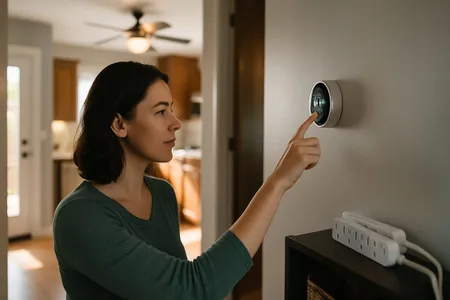
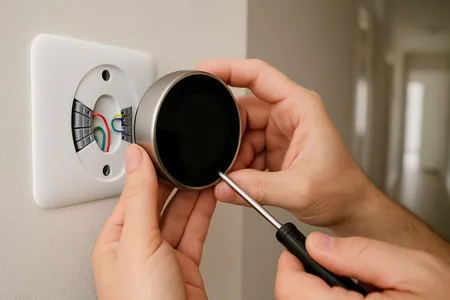
- The thermostat. Confirm the mode (Cool or Heat), confirm the setpoint is at least a few degrees from room temperature, and if the display is dim or blank, replace the batteries. Our guide to resetting your thermostat covers the common models.
- The air filter. Hold it up to a light. If you cannot see light through it, it is choking your system — the single most common cause of HVAC trouble in our dusty, high-pollen area. Here is how to change a furnace filter, and our filter size finder identifies the right replacement.
- The breakers. HVAC systems usually have two — one for the indoor unit, one for the outdoor. A tripped breaker sits in the middle position; reset it fully off, then on. If it trips again immediately, stop and call — repeated resets against a fault can cause damage.
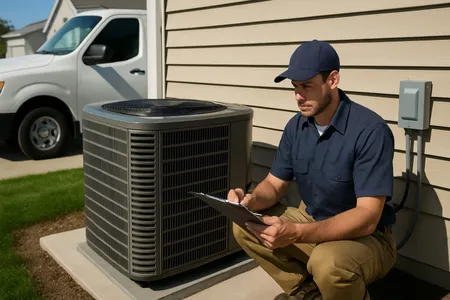
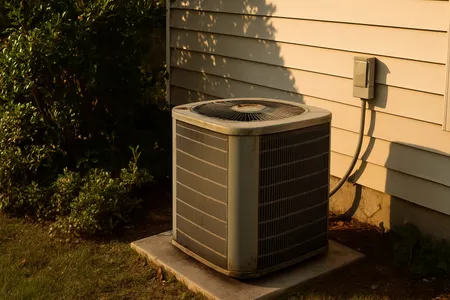
- The outdoor disconnect. The pull-out box on the wall near your outdoor unit. Landscapers and curious kids flip these more often than you would think. Make sure it is seated in the “on” position.
- The drain line float switch. Many Central Texas systems shut themselves off when the condensate drain backs up. If your AC quit on a humid day and there is water near the indoor unit, a clogged drain line is the likely story — see why your AC leaks water inside.
One more, seasonal: if you see ice anywhere on the system, turn cooling off, switch the fan to On, and let it thaw for a few hours before doing anything else. Running an iced-up system risks the compressor — the most expensive component in the machine.
If all five check out and the system still is not working, that is when a diagnostic visit earns its fee. What you have already done will shorten it.
Should I repair or replace my system?
Use the 50 percent rule: when a repair quote exceeds half the cost of a comparable replacement, replacement is usually the smarter investment. Age, refrigerant type, and repair history refine that call — and our free Repair or Replace calculator runs the whole decision for your specific numbers.
Start with age, because everything else keys off it. Find the serial number on the unit’s data plate and run it through our HVAC age decoder — every manufacturer encodes the manufacture date, and the decoder reads 22+ brand formats. (Curious how? Here is how to read an HVAC serial number.)
Then compare against expected lifespan:
| Equipment | Typical lifespan (national) | In Central Texas |
|---|---|---|
| Central air conditioner | 15-20 years | Often 12-17 years — our 8-9 month cooling season adds miles fast |
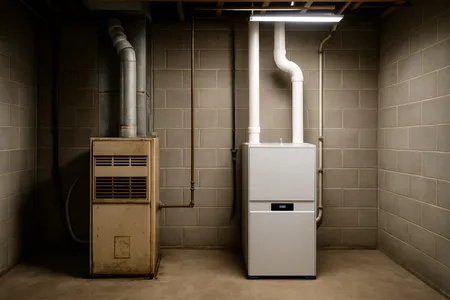
| Gas furnace | 15-20 years | Similar; furnaces work far less here than up north |
| Heat pump | 10-15 years | Cooling-dominant use puts it at the lower end |
| Ductless mini-split | 15-20 years | Similar with regular coil cleaning |
Details by system: how long an AC lasts, how long a furnace lasts, and how long a heat pump lasts.
Beyond the 50 percent rule, lean toward replacement when:
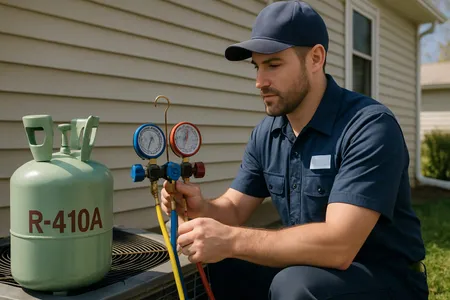
- The system uses R-22 refrigerant (most systems installed before roughly 2010). R-22 is phased out and now costs $150 to $250 per pound versus $50 to $80 for R-410A, which turns every future refrigerant repair into a large bill. Our R-410A phase-out guide explains what the current refrigerant transition means for your next purchase, too.
- This is the second major repair in two years. Components on an aging system share the same miles; failures cluster.
- The system is past roughly three-quarters of its expected lifespan and the repair is expensive. Money into a machine with a few seasons left rarely beats money toward its successor.
Lean toward repair when the system is under about ten years old, the fix is minor (capacitors, contactors, drain lines, and thermostats are the classic examples), or the parts are still under manufacturer warranty — in which case you pay labor only. The full decision framework, with warning signs, is in our guide to when to replace your AC unit.
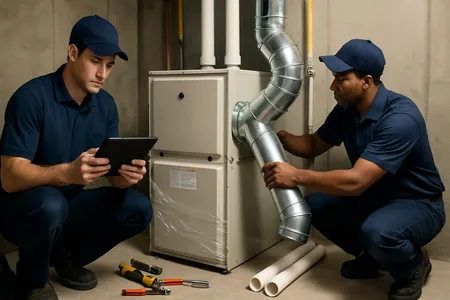
How do I choose an HVAC contractor in Central Texas?
Verify the license, verify the insurance, and insist on a written, itemized quote — in that order. Everything else is preference; those three are protection.
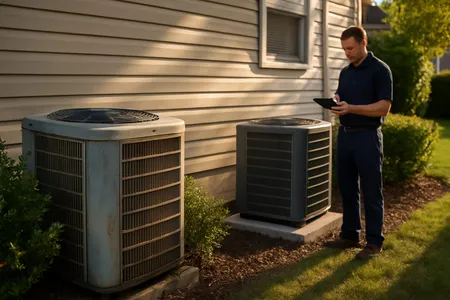
- License. Texas HVAC contractors are licensed by the Texas Department of Licensing and Regulation (TDLR). Ask for the license number before work begins and confirm it is current in TDLR’s public license search. A legitimate company offers the number without being asked twice — ours is on every page of this site (TDLR TACLB78675R).
- Insurance. Liability insurance protects your home if something goes wrong. “Insured and bonded” should be a statement the company will back up on request, not a slogan.
- A written, itemized quote. For anything beyond a simple repair, verbal ballparks are how surprise charges happen. The next section covers exactly what the document should contain.
Beyond the non-negotiables, Central Texas rewards contractors with local knowledge. Our area has specific failure patterns an out-of-town outfit misses: limestone soil that shifts foundations and cracks ductwork, hard water in Bell and McLennan counties that scales up coils and drain lines, cedar pollen that packs outdoor coils every winter, and a large stock of 1990s-2000s homes still running original R-22 equipment. Our guide to choosing an HVAC contractor in Temple goes deep on the local questions worth asking, and it applies across the Killeen-Temple-Waco corridor.
For replacements specifically, one more filter: a contractor who quotes you a system size over the phone, without measuring anything, is guessing with your money. Proper sizing uses a Manual J load calculation — square footage, insulation, windows, orientation — because in our humid climate an oversized AC short-cycles and leaves the house clammy. Our guide to what size AC a Texas house needs explains the sizing logic, and our BTU calculator gives you an independent estimate to sanity-check any quote. On brands, the honest answer is that installation quality matters more than the nameplate — but the differences that do exist are ranked in our best HVAC brands for Texas guide.
What does a fair HVAC quote look like?
A fair quote is specific enough that a second contractor could execute it without asking you a single question. For a replacement, that means it names:
- The exact equipment — brand and model numbers for every component, not “3-ton high-efficiency system.”
- The size and the basis for it — tonnage, and ideally a reference to the load calculation behind it.
- The efficiency rating — SEER2 for cooling (the post-2023 standard; our SEER vs SEER2 guide explains the change). The federal minimum for new split-system ACs in southern states is 14.3 SEER2; for our cooling season, 16-18 SEER-class equipment is the value sweet spot for most homes.
- The full scope — ductwork modifications, electrical work, thermostat, permit, haul-away, and startup. These are where “too good to be true” quotes hide their gaps.
- Warranty terms, separated — manufacturer parts warranty (often ten years when registered) versus the contractor’s own labor warranty. They are different promises from different parties.
- The total price and payment terms.
For a repair quote, the same principle at smaller scale: the diagnosis, the part, the labor, and the total, so you can apply the 50 percent rule with real numbers.
Two timing notes worth money. Replacement demand collapses in the shoulder seasons — late fall and early spring quotes often come in 5 to 15 percent lower than peak summer, when demand pricing and wait times are at their worst. And on tax incentives: the federal 25C credit that covered qualifying HVAC upgrades ended December 31, 2025, so treat any quote that still touts a “30 percent federal tax credit” as a red flag on the contractor’s homework — our 2026 tax credits and rebates guide covers what actually remains, including utility rebates.
If a quote feels wrong — pressure to sign today, a scary diagnosis with no evidence shown, a price wildly out of line with the ranges below — getting a second opinion on a four-figure verdict is normal and reasonable. Any contractor offended by that is telling you something.
What does HVAC work cost in Central Texas?
Repairs mostly land between $250 and $700; replacements run four to five figures depending on system type. The table below consolidates the ranges from our detailed cost guides, which we keep updated; the deep links break each number down by brand, size, and scenario.
| Service | Typical published range | Full breakdown |
|---|---|---|
| Diagnostic + common AC repair | $250 - $700 (minor fixes $75 - $400) | AC repair cost guide |
| Capacitor replacement | $150 - $350 | AC repair cost guide |
| Refrigerant recharge | $200 - $600 | AC repair cost guide |
| Refrigerant leak repair | $400 - $1,500 | AC repair cost guide |
| Compressor replacement | $1,000 - $3,000 | AC repair cost guide |
| AC replacement (unit + install) | $3,900 - $12,500; most homeowners $5,900 - $7,900 | AC replacement cost guide |
| New AC installed, Central Texas | $5,800 - $13,500 depending on size, efficiency, brand tier | Central Texas HVAC guide |
| Full system (AC + furnace) | Most homeowners $10,000 - $14,000 | HVAC system cost guide |
| Furnace replacement | $3,000 - $10,000; average $5,500 - $7,500 | Furnace replacement cost guide |
| Heat pump installation | Most homeowners $8,000 - $15,000 | Heat pump cost guide |
| Mini-split installation | Single zone from about $2,000; multi-zone higher | Mini-split cost guide |
| Professional tune-up | $85 - $250 per visit; most pay $150 - $200 | HVAC maintenance cost guide |
| Annual maintenance plan | $150 - $500 per year for two visits | HVAC maintenance cost guide |
| Duct cleaning | $300 - $1,000 — and not always necessary | Duct cleaning cost guide |
Three notes on reading these numbers honestly. First, they are ranges, not quotes — your home’s size, ductwork, and electrical situation move the number, which is why the itemized-quote section above matters. Second, southern-region labor typically prices at or slightly below the national averages these ranges reflect, so Central Texas quotes near the top of a range deserve a “what’s driving that?” question. Third, timing is part of the price: the same repair costs 50 to 100 percent more after hours, and the same replacement often costs less in the shoulder season. For a personalized starting number, our cost estimator builds good/better/best pricing for your situation.
How does the Central Texas climate change the answers?
Almost every piece of national HVAC advice needs a Central Texas correction, and the corrections all trace to one fact: our cooling season runs 8 to 9 months. Killeen, Temple, and Waco sit in a hot-humid climate zone where summer highs of 96-100°F are routine and air conditioning is the system that determines both your comfort and your electric bill.
What that means in practice:
- Systems age faster. A Central Texas AC works roughly half again more hours per year than the national assumption behind “15-20 year lifespan” — which is why local systems are often done at 10-15 years, and why the repair-or-replace math tips earlier here.
- Sizing is about humidity, not just heat. An oversized AC cools the air quickly and shuts off before it dehumidifies, leaving the house cold and clammy while short-cycling itself to an early death. This is why the Manual J calculation in the contractor section is not paperwork theater.
- Your ducts live somewhere brutal. Most homes here run ductwork through unconditioned attics that reach 130-150°F in summer. Leaky or poorly insulated attic ducts throw away cooling you paid for — a factor in both high bills and rooms that never get comfortable.
- Winter is a filter problem, not just a heating problem. Cedar pollen season (December-February) packs outdoor coils and clogs filters at exactly the time of year most homeowners stop thinking about their HVAC.
- Hard water bites quietly. Bell and McLennan county water scales up condensate drains and any water-touching equipment, one more reason drain-line clogs are a local specialty.
- Mild winters still bite. The 2021 winter storm proved heating capacity matters here; a heat pump’s efficiency profile fits our climate well, and the heat pump vs furnace question for Texas deserves a real comparison before your next replacement.
Our complete Central Texas HVAC guide collects every local resource — service pages for each city, error-code lookups, and all our free tools — in one directory.
What seasonal care does my system need here?
Two professional tune-ups anchor the year — AC in March-April, heating in September-October — and the rest is filters, awareness, and preparation timed to our seasons.
| Season | What to do | Guides |
|---|---|---|
| Spring (Feb-Apr) | Schedule the AC tune-up before the first heat wave, run the DIY prep checklist, clean the outdoor coil after cedar season | Prepare your AC for summer · Clean your AC condenser |
| Summer (May-Sep) | Filters every 30-60 days, keep two feet clear around the outdoor unit, watch for warm-air and icing symptoms early — waiting turns repairs into emergencies | AC not blowing cold air · Thermostat settings that save money |
| Fall (Sep-Nov) | Heating tune-up before the first cold snap — furnaces that sat idle for 8-9 months fail on first ignition, not in July | Winter HVAC maintenance in Texas |
| Winter (Dec-Feb) | Stay on filters through cedar pollen season, protect pipes and equipment ahead of hard freezes | How to winterize your home |
The full month-by-month version — including the two tasks that matter most if you do nothing else — is our Central Texas HVAC maintenance calendar, and our interactive maintenance checklist tool tracks your progress through it.
What maintenance actually matters, and what does it cost?
Filters and tune-ups. If you do only two things, do those — everything else is refinement.
- Filters: every 30-60 days in cooling season, 60-90 days otherwise. It is the cheapest insurance in home ownership: a clogged filter is the number-one cause of HVAC problems in our dusty conditions, and it makes everything downstream — coils, blower, compressor — work harder. Our filter size finder takes the guesswork out.
- Two tune-ups per year: $85-$250 per visit, most people pay $150-$200. A maintenance plan bundling both visits typically runs $150-$500 per year and usually includes priority scheduling — which matters in July. What a tune-up actually includes, and when a plan pays for itself, is covered in our maintenance cost guide; our own maintenance plans follow that model.
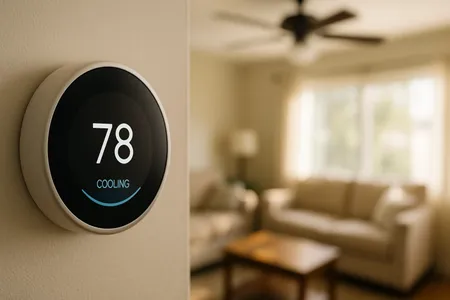
- Thermostat discipline: the DOE-recommended 78°F summer / 68°F winter, with setbacks when away, saves roughly 10 percent on heating and cooling. Every degree below 78 in summer adds roughly 3 to 4 percent to cooling costs. The full season-by-season playbook is in what temperature to set your thermostat and thermostat settings that save money, and our thermostat savings calculator puts your numbers on it.
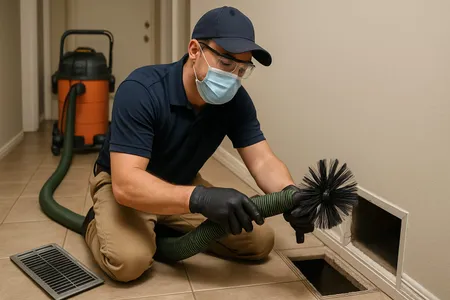
- Duct cleaning: sometimes. At $300-$1,000, it is worth it after renovations, pest problems, or visible mold — and skippable on a clean, well-filtered system. Be wary of $99 whole-house offers; our duct cleaning guide explains when it is genuinely worth paying for, and improving indoor air quality covers the alternatives that often matter more.
- The electric bill is part of maintenance. A creeping summer bill with no rate change is often an efficiency symptom — see how to lower your electric bill and our energy cost calculator to establish your baseline.
Which system should I choose when it is time to replace?
For most Central Texas homes the real question is not the brand — it is the configuration. The short version of each decision, with the full comparison one click down:
- Heat pump vs. AC + furnace: in our mild-winter, long-summer climate, heat pumps fit well and heat far more efficiently than electric resistance; gas furnaces still win on cold-snap grunt and gas-line economics. Start with heat pump vs furnace for Texas and heat pump vs AC.
- Gas vs. electric furnace: operating cost versus install simplicity — the comparison.
- Ducted vs. ductless: for additions, garages, and homes without ducts, mini-splits vs central AC covers the tradeoffs.
- Single-stage vs. two-stage vs. variable-speed: the compressor technology decision that most affects humidity control here — explained.
- Efficiency tier: SEER vs SEER2 decodes the ratings; our energy savings calculator projects the 10-year payback for your usage.
- Brand: ranked for Texas — with the caveat, worth repeating, that the installer’s quality matters more than the logo.
Size it with a real load calculation (why, calculator), price it against the ranges above (estimator), and take quotes in the shoulder season if you can.
Glossary: HVAC terms in plain English
| Term | Plain English |
|---|---|
| SEER2 | The efficiency rating for air conditioners under the 2023 test standard — higher means cheaper to run. Replaces SEER; roughly, SEER ÷ 1.05 ≈ SEER2. |
| AFUE | Furnace efficiency: the percentage of fuel that becomes heat in your home. An 80% AFUE furnace sends 20 cents of every fuel dollar up the flue. |
| Ton / BTU | AC capacity. One ton = 12,000 BTU per hour of cooling. A typical home system is 2-5 tons. Bigger is not better — see short cycling. |
| Manual J | The industry-standard load calculation that determines what size system your specific house needs. Insist on it for replacements. |
| Capacitor | A small electrical part that starts the motors. Frequent failure item in Texas heat; cheap fix ($150-$350) that mimics expensive failures. |
| Compressor | The heart of the outdoor unit — pumps refrigerant. The most expensive single component; its health often decides repair-vs-replace. |
| Condenser / evaporator coil | The outdoor coil that dumps heat and the indoor coil that absorbs it. Both need to be clean to work. |
| Refrigerant (R-22 / R-410A / R-32) | The working fluid. R-22 is phased out and expensive ($150-$250/lb); R-410A is current and itself now transitioning to newer blends like R-32. |
| Heat pump | An AC that can run in reverse to heat your home. In mild-winter climates like ours, one machine can do both jobs efficiently. |
| Short cycling | Starting and stopping every few minutes — the signature of an oversized or struggling system. Wears equipment and skips dehumidification. |
| Condensate drain line | The pipe that carries away the water your AC wrings out of humid Texas air. When it clogs, systems leak or shut down. |
| TDLR | The Texas Department of Licensing and Regulation — the state body that licenses HVAC contractors. Verify any contractor’s number there. |
| EPA 608 | The federal certification legally required to handle refrigerants. Anyone recharging your system should hold it. |
Frequently asked questions
How often should I service my HVAC system in Central Texas?
Twice per year: an AC tune-up in spring (March-April) before the cooling season, and a heating tune-up in fall (September-October). Change your air filter every 30-60 days during the May-September cooling season and every 60-90 days the rest of the year. Central Texas systems run an 8-9 month cooling season, so skipped maintenance shows up faster here than in most of the country.
How long do AC units last in Central Texas?
The national average for a central air conditioner is 15 to 20 years, but Central Texas systems often reach end-of-life at 10 to 15 years because of our extended 8-9 month cooling season and extreme summer heat. Hard water in Bell and McLennan counties can shorten that further through mineral buildup on coils. Use our HVAC age decoder to find your system’s exact manufacture year.
How much does AC repair cost?
Most AC repairs run $250 to $700. Minor fixes like a capacitor replacement cost $150 to $350, refrigerant recharges run $200 to $600, and major repairs like a compressor replacement run $1,000 to $3,000. Emergency and after-hours calls typically cost 50 to 100 percent more than standard business-hour visits, so if the problem can safely wait until morning, waiting saves money.
Should I repair or replace my HVAC system?
Apply the 50 percent rule: if the repair quote exceeds half the cost of a comparable replacement, replacing is usually the smarter investment. Also lean toward replacement if the system is past roughly three-quarters of its expected lifespan, if it uses phased-out R-22 refrigerant ($150 to $250 per pound), or if this is the second major repair in two years. Our Repair or Replace calculator runs the numbers for your case.
What counts as an HVAC emergency?
Treat these as emergencies: a gas odor (turn off the gas supply, leave the building, and call your gas company first), electrical sparking or a burning smell, no cooling during extreme heat when infants, elderly family members, or medically vulnerable people are in the home, no heat during a hard freeze, and water actively leaking onto floors or ceilings. Most other problems can wait for a standard business-hours appointment, which costs significantly less.
How do I verify an HVAC contractor’s license in Texas?
Texas HVAC contractors are licensed by the Texas Department of Licensing and Regulation (TDLR). Ask any contractor for their license number before work begins and look it up in TDLR’s public license search to confirm it is current. A legitimate company provides the number without hesitation; Texas Temp Masters’ license is TDLR TACLB78675R.
What SEER2 rating should I buy in Central Texas?
The federal minimum for new split-system air conditioners in southern states is 14.3 SEER2. For Central Texas’ long cooling season, a 16 to 18 SEER-class system is the value sweet spot for most homeowners: the efficiency gain pays back meaningfully over an 8-9 month cooling season, while ratings above 18 have diminishing returns unless you plan to stay in the home long-term. See SEER vs SEER2 for how the ratings work.
What should I set my thermostat to in a Texas summer?
The U.S. Department of Energy recommends 78 degrees Fahrenheit while you are home and 85 degrees while you are away in summer. Each degree below 78 increases cooling costs by roughly 3 to 4 percent. Ceiling fans, closed blinds on west-facing windows, and a programmable schedule make 78 feel comfortable without lowering the setpoint — details in what temperature to set your thermostat.
When you are ready to talk to a person
Guides and calculators take you a long way, but at some point the question becomes “what is wrong with my system” — and that takes a technician in your driveway. Texas Temp Masters is a licensed HVAC and appliance repair company led by an owner with 15+ years in HVAC, serving Killeen, Waco, Temple, Harker Heights, Belton, Copperas Cove, and the surrounding Central Texas communities.
- Call us at (817) 704-0706 — same-day service is available.
- Request service online and we will get back to you promptly.
- For emergencies, our emergency HVAC repair page explains what to do right now, and the phone number above is the fastest path.
Whatever you decide — DIY check, second opinion, repair, or replacement — you now know what a fair version of each step looks like. That was the point of this guide.