When your water heater needs replacing, you face a fundamental choice: stick with a traditional tank or upgrade to a tankless model? Each has clear advantages and trade-offs. This guide covers everything you need to make a confident decision.
Quick Comparison: Tankless vs Tank Water Heater
| Feature | Tank Water Heater | Tankless Water Heater |
|---|---|---|
| How it works | Stores and heats 30-80 gallons | Heats water on demand |
| Upfront cost (installed) | Lower — ask for a written quote | Higher — ask for a written quote |
| Energy savings | Baseline | 25 - 35% less energy |
| Lifespan | 10 - 15 years | 20+ years |
| Hot water supply | Limited by tank size | Unlimited (flow-rate limited) |
| Space needed | 16 - 24 sq ft | 2 - 4 sq ft (wall-mounted) |
| Recovery time | 30 - 60 min after depletion | Instant (continuous) |
| Maintenance | Annual flush, anode check | Annual flush, filter cleaning |
How Each Type Works
Tank Water Heater
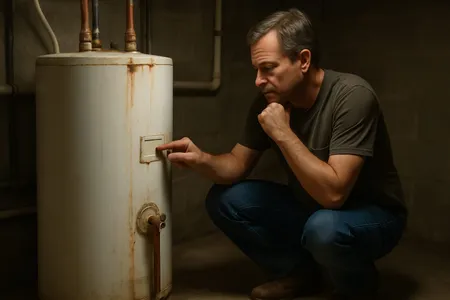
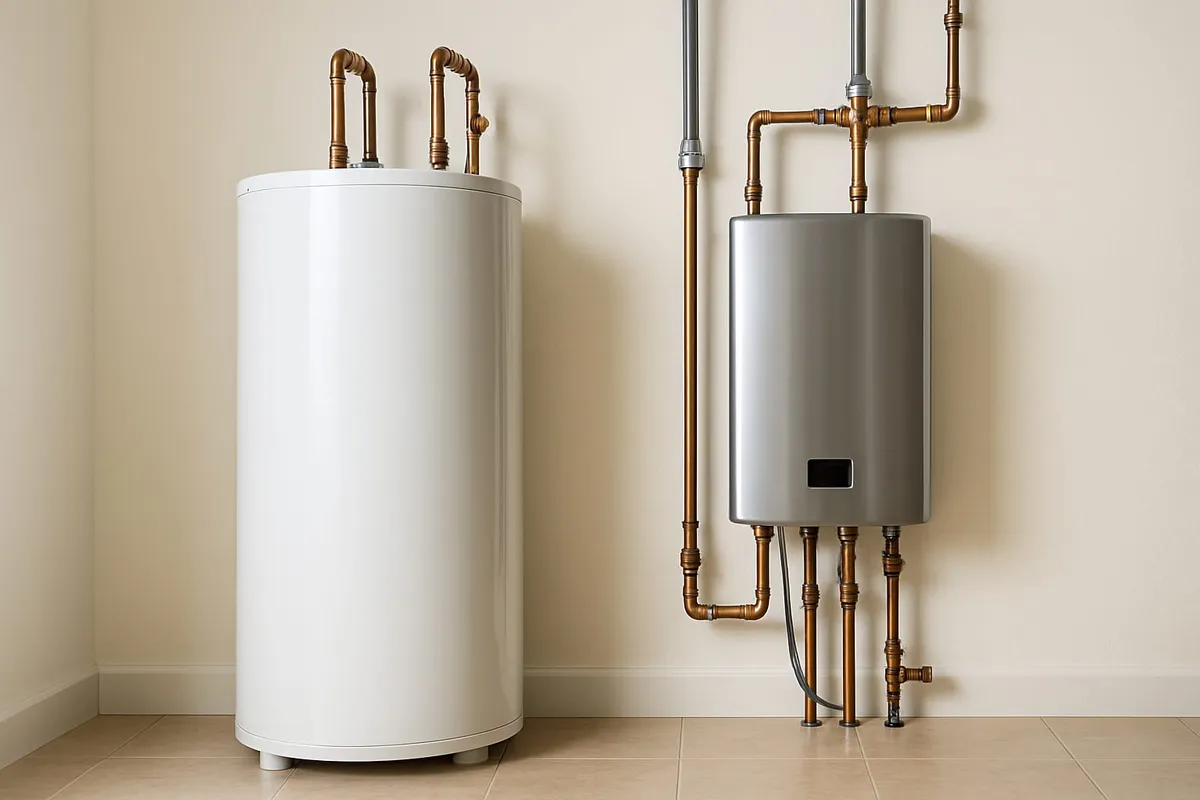
A tank water heater stores a large volume of water (typically 40 to 80 gallons) in an insulated tank and keeps it heated to your set temperature (usually 120 degrees Fahrenheit) at all times. When you turn on a hot water tap, heated water flows from the top of the tank while cold water enters at the bottom to be heated.
The tank continuously maintains water temperature, which means it uses energy even when you are not using hot water. This “standby heat loss” accounts for a significant portion of the energy consumed.
Tankless Water Heater
A tankless (or on-demand) water heater does not store water. When you open a hot water tap, cold water flows through the unit, where a gas burner or electric element heats it instantly. Water is heated only when you need it, eliminating standby energy loss.
The trade-off is flow rate: a tankless unit can only heat a certain volume per minute (measured in gallons per minute, or GPM). If you exceed that flow rate by running multiple hot water fixtures simultaneously, the temperature may drop.
Pros and Cons
Tank Water Heater Pros
- Lower upfront cost: Costs less to install than a tankless system — ask for a written quote for your home
- Simpler installation: No special venting, gas line upgrades, or electrical work typically needed for a like-for-like replacement
- Handles simultaneous demand well: A 50-gallon tank provides a large reservoir of hot water
- Works during power outages: Gas models with standing pilot lights work without electricity
- Widely available: Every plumber is familiar with tank water heater installation
- Lower repair costs: Simpler components, widely available parts
Tank Water Heater Cons
- Limited hot water: Once the tank is empty, you wait 30 to 60 minutes for recovery
- Higher operating costs: Standby heat loss wastes 15% to 25% of energy
- Shorter lifespan: 10 to 15 years, roughly half that of tankless
- Large footprint: Takes up 16 to 24 square feet of floor space
- Risk of water damage: A leaking or failing tank can release 40 to 80 gallons of water
- Sediment buildup: Requires regular flushing to prevent efficiency loss
Tankless Water Heater Pros
- Unlimited hot water: Heats water on demand as long as flow rate is within capacity
- Lower operating costs: 25% to 35% lower energy usage
- Longer lifespan: 20+ years, with replaceable components extending life further
- Compact size: Wall-mounted, freeing up floor space
- No standby energy loss: Only heats water when needed
- Lower risk of water damage: No large stored volume to leak
- Higher resale value: Modern tankless systems are attractive to home buyers
Tankless Water Heater Cons
- Higher upfront cost: Costs more to install than a tank, and more still for fuel conversions — ask for a written, itemized quote
- Flow rate limitations: Running too many fixtures at once reduces water temperature
- Cold water sandwich: Brief cool water between hot water uses in some models
- More complex installation: May need gas line upgrades, special venting, or electrical upgrades
- Higher repair costs: More complex components, specialized service
- Annual maintenance critical: Requires descaling, especially in hard water areas
- Brief delay to hot water: Takes 2 to 5 seconds to activate and deliver hot water
Cost Comparison
Upfront Costs
Equipment, installation labor, and any additional work (gas line, venting, or electrical upgrades) all add to the total, and all four vary by fuel type, home, and contractor. A gas or electric tank costs less installed than a gas or electric tankless unit. Get a written, itemized quote from your plumber for your specific home and fuel type.
Annual Operating Costs
Energy cost and maintenance both factor into the annual total, and both vary by fuel type and local rates — tankless units generally run lower on energy but can run higher on annual maintenance (the required descaling) than a tank. Your local utility rates determine the actual numbers.
Lifetime Cost Comparison (Over Time)
Over a system’s full lifespan, a tankless water heater often costs less than a tank despite the higher upfront investment, primarily because of lower energy costs and not needing a mid-life replacement (tanks typically fail and need replacing well before a tankless unit does). The size of that advantage depends on your local energy rates and how much hot water your household uses.
For detailed pricing, see our Water Heater Replacement Cost guide.
Which Is Better for Different Situations
Choose a Tank Water Heater If:
- Your budget is tight: You need the lowest upfront cost now
- Your household uses hot water in large bursts: Filling bathtubs, running multiple showers plus the dishwasher simultaneously
- You are doing a like-for-like replacement: Same fuel type, same location, minimal changes
- You live in an area with soft water: Less scaling means less maintenance difference
- You plan to sell your home soon: The lower upfront investment makes more sense
Choose a Tankless Water Heater If:
- You plan to stay in your home 5+ years: The payback period is typically 5 to 8 years
- You frequently run out of hot water: Tankless provides an endless supply
- You want lower monthly utility bills: 25% to 35% less energy usage
- Space is limited: Tankless units mount on a wall and free up floor space
- You live in a hard water area: With annual descaling, tankless units handle hard water well
- You value longevity: 20+ year lifespan vs. 10-15 for tank models
Consider a Heat Pump Water Heater
A heat pump water heater is a third option worth considering. It uses a tank but heats water using heat pump technology (similar to a reverse air conditioner), achieving 2 to 3 times the efficiency of a standard electric tank. They typically cost more installed than a standard electric tank — ask for a written quote. A federal tax credit for these expired December 31, 2025 — see our 2026 tax credits guide for what’s still available.
Expert Recommendation
For most homeowners, the decision breaks down simply:
- Replacing a functioning water heater on a budget? Stick with a tank. The lower upfront cost and simpler installation make it the practical choice.
- Your tank failed and you want to upgrade? Go tankless, especially if you plan to stay in your home 5+ years. The energy savings and longer lifespan justify the higher upfront cost.
- You have high hot water demand? A tankless unit eliminates the “running out of hot water” problem entirely, though you may need a higher-capacity unit or two tankless units for very large homes.
- You want maximum efficiency? A heat pump water heater offers the best efficiency for a tank-style unit, while a gas condensing tankless is the most efficient on-demand option.
Frequently Asked Questions
How much money does a tankless water heater save?
The U.S. Department of Energy estimates tankless water heaters are 24% to 34% more energy efficient than tank models for homes using 41 gallons or less per day. How much that saves in dollar terms depends on your household’s hot water usage and local energy rates.
Can a tankless water heater supply a whole house?
Yes, if properly sized. A whole-house gas tankless unit with 8 to 11 GPM can handle most households. Very large homes or homes with high simultaneous demand may need two tankless units or a high-capacity condensing model.
How long does it take to get hot water from a tankless unit?
Tankless water heaters take 2 to 5 seconds to activate and begin heating water. You will also experience the normal delay of hot water traveling through your pipes (same as with a tank). For instant hot water at the tap, consider a recirculation pump — ask a plumber for an installed quote.
Does a tankless water heater need maintenance?
Yes. Annual flushing with white vinegar is recommended to remove mineral scale, especially in hard water areas. The inlet filter should be cleaned every 6 months. Professional descaling cost varies by unit and water hardness — ask your plumber for a quote. Neglecting maintenance can shorten the unit’s lifespan and reduce efficiency.
Is it hard to switch from tank to tankless?
The installation is more involved than a like-for-like tank replacement. Expect the installer to upgrade the gas line (for gas models), add or modify venting, and potentially upgrade the electrical panel (for electric models). These modifications add to the installation cost — ask your installer for a written, itemized quote.
Choosing between tank and tankless? Use the comparison above to match the right option to your household’s hot water needs and budget, then get quotes from a licensed plumber for installation.
Next Steps
Now that you understand the differences between tank and tankless, here is how to move forward:
- Is it time to replace? — Enter your water heater’s serial number into our Appliance Age Decoder to see exactly how old it is.
- Repair or replace? — If your unit is struggling but still running, our Repair or Replace Calculator can help you decide.
- Compare long-term energy costs — Model out your annual savings with our Energy Savings Calculator to see when a tankless upgrade pays for itself.
- Get the full cost picture — Our Water Heater Replacement Cost guide breaks down pricing by size, fuel type, and brand.
- Check what’s still available — The federal tax credit for heat pump water heaters expired December 31, 2025; see the 2026 HVAC Tax Credits guide for remaining incentives.
- Ready to talk? — Contact us for a free evaluation.