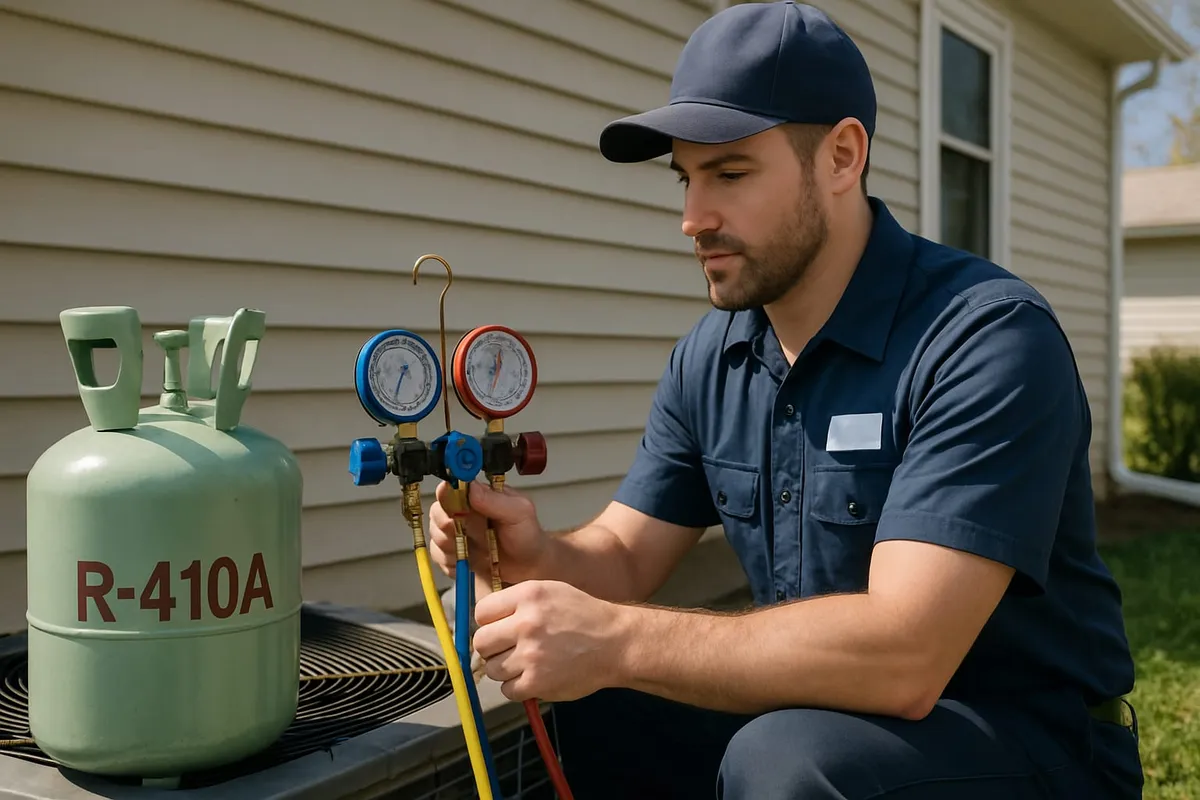
If you own a central air conditioner or heat pump, you have likely heard about the R-410A refrigerant phase-out. There is a lot of confusing (and sometimes alarming) information circulating. This guide separates fact from fiction and explains exactly what this means for you as a homeowner.
Quick Comparison: R-410A vs New Refrigerants
| Feature | R-410A (Puron) | R-454B (Puron Advance) | R-32 |
|---|---|---|---|
| Status | Being phased out | Primary replacement | Alternative replacement |
| Global Warming Potential | 2,088 | 466 | 675 |
| GWP reduction | Baseline | 78% lower | 68% lower |
| Flammability | Non-flammable (A1) | Mildly flammable (A2L) | Mildly flammable (A2L) |
| Efficiency | Good | Comparable to R-410A | Slightly better than R-410A |
| Equipment cost | Standard (declining stock) | 10-15% higher initially | 10-15% higher initially |
| Available for service | Yes (for existing systems) | For new equipment | For new equipment |
What Is Happening and Why
The Phase-Out Timeline
R-410A (also known by Carrier’s brand name “Puron”) has been the standard refrigerant in residential air conditioners and heat pumps since the early 2000s, when it replaced R-22 (Freon). Now, R-410A itself is being phased down because of its high Global Warming Potential (GWP).
Key dates:
| Date | What Happens |
|---|---|
| January 1, 2025 | New residential AC/heat pump equipment must be manufactured with low-GWP refrigerants (not R-410A) |
| January 1, 2026 | R-410A equipment manufactured before the deadline can no longer be installed as new equipment in most jurisdictions |
| 2025-2035 | Gradual reduction in R-410A production for service/maintenance |
| 2036+ | R-410A production significantly restricted; service costs will increase |
Why R-410A Is Being Phased Out
R-410A is a hydrofluorocarbon (HFC) with a GWP of 2,088, meaning it traps 2,088 times more heat than carbon dioxide over a 100-year period. Under the American Innovation and Manufacturing (AIM) Act of 2020, the EPA is required to reduce HFC production and consumption by 85% by 2036.
This is not a ban on existing equipment. It is a manufacturing and production phase-down that gradually reduces the amount of R-410A available.
What This Means for Your Current AC System
If Your System Uses R-410A
Your system is not going to stop working. Here is what you need to know:
- No immediate action required: You are not required to replace your R-410A system
- It will continue to work: Your current AC or heat pump will operate normally for its remaining lifespan
- Service is still available: R-410A will remain available for maintenance and repairs for many years
- Costs will gradually increase: As R-410A production decreases, the price for service refrigerant will rise over time
If Your System Uses R-22 (Freon)
If you still have an R-22 system, you are in a different situation. R-22 was fully phased out of production in 2020, and the supply is now extremely limited and expensive:
- R-22 costs $150 per pound, compared to $90 per pound for R-410A (parts only; labor for the recharge is separate, and prices may vary case by case)
- A full recharge’s total cost depends on how many pounds your system needs — ask your technician for a written quote once they’ve assessed the leak
- Replacement is strongly recommended
How Service Costs Will Change
Refrigerant service costs are expected to rise gradually as R-410A production is phased down and R-22 supply continues to shrink. R-22 is already far more expensive than R-410A per pound today, and that gap is likely to widen over time as R-22 becomes harder to source. Exactly how fast prices move depends on market conditions and remaining inventory — ask for current pricing when you call, since it shifts as the phase-down progresses.
The New Refrigerants: What Is Replacing R-410A?
R-454B (Primary Replacement)
R-454B (marketed by Carrier as “Puron Advance”) is the leading replacement for R-410A in residential systems:
- 78% lower GWP than R-410A (466 vs. 2,088)
- Comparable efficiency to R-410A systems
- Mildly flammable (A2L classification): Requires safety measures in equipment design but poses minimal risk in properly designed and installed systems
- Not a drop-in replacement: R-454B cannot be used in existing R-410A equipment
R-32
R-32 is another low-GWP alternative used by some manufacturers:
- 68% lower GWP than R-410A (675 vs. 2,088)
- Slightly better efficiency than R-410A in some applications
- Also A2L classification (mildly flammable)
- Widely used internationally: Already the standard in many countries
Safety of A2L Refrigerants
The “mildly flammable” classification of R-454B and R-32 understandably concerns some homeowners. Here are the facts:
- A2L refrigerants require a direct flame source and specific conditions to ignite
- New equipment is designed with safety features (leak detection, automatic shutoff)
- Updated building codes include safety requirements for A2L refrigerant systems
- Risk of ignition in a properly installed residential system is extremely low
- The HVAC industry has been preparing for this transition for years
How This Affects HVAC Costs
Equipment Price Impact
The transition to new refrigerants has affected equipment pricing:
| Cost Impact | Amount | Reason |
|---|---|---|
| New equipment premium | 10 - 15% higher | New refrigerant system design, components, safety features |
| R-410A equipment (remaining stock) | May be discounted | Dealers clearing inventory |
| Installation costs | Slight increase | Additional safety requirements, new procedures |
Should You Buy an R-410A System Now?
As of 2026, the window for purchasing and installing new R-410A equipment has essentially closed in most jurisdictions. However, here is the broader context:
Arguments for a new low-GWP system:
- Future-proofed for regulatory changes
- Service refrigerant will remain readily available and affordable
- May qualify for additional incentives
- Latest technology and highest efficiency
Note on remaining R-410A stock:
- Some dealers may still have R-410A units manufactured before January 2025
- Installation deadlines vary by jurisdiction
- R-410A systems are fully functional and will be serviceable for years
- Check local regulations for specific deadlines in your area
What You Should Do: Action Guide
If Your AC Is Working Fine (Under 10 Years Old)
Do nothing. Your system will continue to operate normally. R-410A will be available for service and repairs for many years. Enjoy your current system and plan to upgrade when it eventually needs replacement.
If Your AC Is 10-15 Years Old
Start planning, but do not rush. Your system is approaching the end of its typical lifespan. Begin budgeting for a replacement with a new low-GWP refrigerant system. When your system needs a major repair, consider whether replacement makes more sense.
Use our Repair or Replace Calculator to help make this decision.
If Your AC Uses R-22
Replace as soon as budget allows. R-22 is already extremely expensive for service, and prices will only increase. Upgrading to a new system with R-454B will save you significantly on service costs while providing much better efficiency.
If You Are Building or Renovating
Choose a system with R-454B or R-32. There is no reason to install R-410A equipment in new construction or major renovations at this point.
Frequently Asked Questions
Will R-410A become illegal?
No. Owning, operating, and servicing an R-410A system will remain legal. The phase-out applies to manufacturing new equipment and gradually reducing production of the refrigerant itself. Your existing system is not affected by any ban.
Can R-454B be put in my R-410A system?
No. R-454B is not a drop-in replacement for R-410A. The systems are designed for specific refrigerants and cannot be converted. Using the wrong refrigerant will damage equipment and void warranties.
How long will R-410A be available for repairs?
R-410A will be available for service and repairs for many years, likely well into the 2030s and beyond. Production is being reduced gradually, not eliminated overnight. However, costs will increase over time as supply tightens.
Is the R-410A phase-out like the R-22 (Freon) phase-out?
Similar, but less dramatic. R-22 was completely banned from production in 2020, and the supply became extremely limited and expensive. The R-410A transition is a gradual “phase-down” that reduces production over a longer period. R-410A will remain more accessible for longer than R-22 has been.
Will my home insurance be affected?
No. Having an R-410A system will not affect your home insurance. These systems are perfectly legal and safe to operate for their entire remaining lifespan.
Do I need to worry about the A2L flammability of new refrigerants?
The risk is minimal. A2L refrigerants have very low flammability and require specific conditions to ignite that are extremely unlikely in a residential setting. New equipment includes built-in safety features like leak detection sensors. Thousands of A2L systems have been installed globally without incidents.
The Big Picture
The R-410A phase-out is a positive development for the environment that will have a gradual, manageable impact on homeowners. The key takeaways are:
- Your current system is fine. No one is forcing you to replace it.
- Service will remain available for years to come, though costs will gradually increase.
- When you do replace, you will get a system with comparable or better performance using a more environmentally friendly refrigerant.
- The transition is orderly. The HVAC industry has been preparing for this for years, and the new systems are proven technology.
- Budget for slightly higher equipment costs (10-15%) when you eventually replace your system.
For help evaluating your current system and planning for the future, use our Cost Estimator and Energy Savings Calculator.
Next Steps
Use these resources to figure out where your system stands and what to do about it:
- Find out how old your system is — Enter your serial number into our HVAC Age Decoder to confirm your system’s manufacture date and refrigerant type.
- Check what a refrigerant recharge costs — Our Refrigerant Cost Calculator shows current pricing for R-22, R-410A, and newer refrigerants so you can weigh repair costs against replacement.
- Budget for a new system — If replacement makes sense, our HVAC System Cost guide breaks down pricing by system type, home size, and efficiency level.
- Offset the cost with incentives — The federal tax credit expired December 31, 2025, but state and utility rebates can still reduce the price of a new high-efficiency system. See our HVAC Tax Credits and Rebates in 2026 guide for what’s still available.
- Decode your serial number yourself — Our guide on How to Read Your HVAC Serial Number shows where to find the data plate and how each brand encodes the manufacture date.
- Ready to talk? — Contact us for a free consultation on your system’s options.
In Central Texas? Texas Temp Masters stays current with all refrigerant regulations and installs the latest systems using approved low-GWP refrigerants. Whether you need service on your existing R-410A system or are ready to upgrade, we can help. Call (817) 704-0706 for a free consultation, or visit our Air Conditioning page.