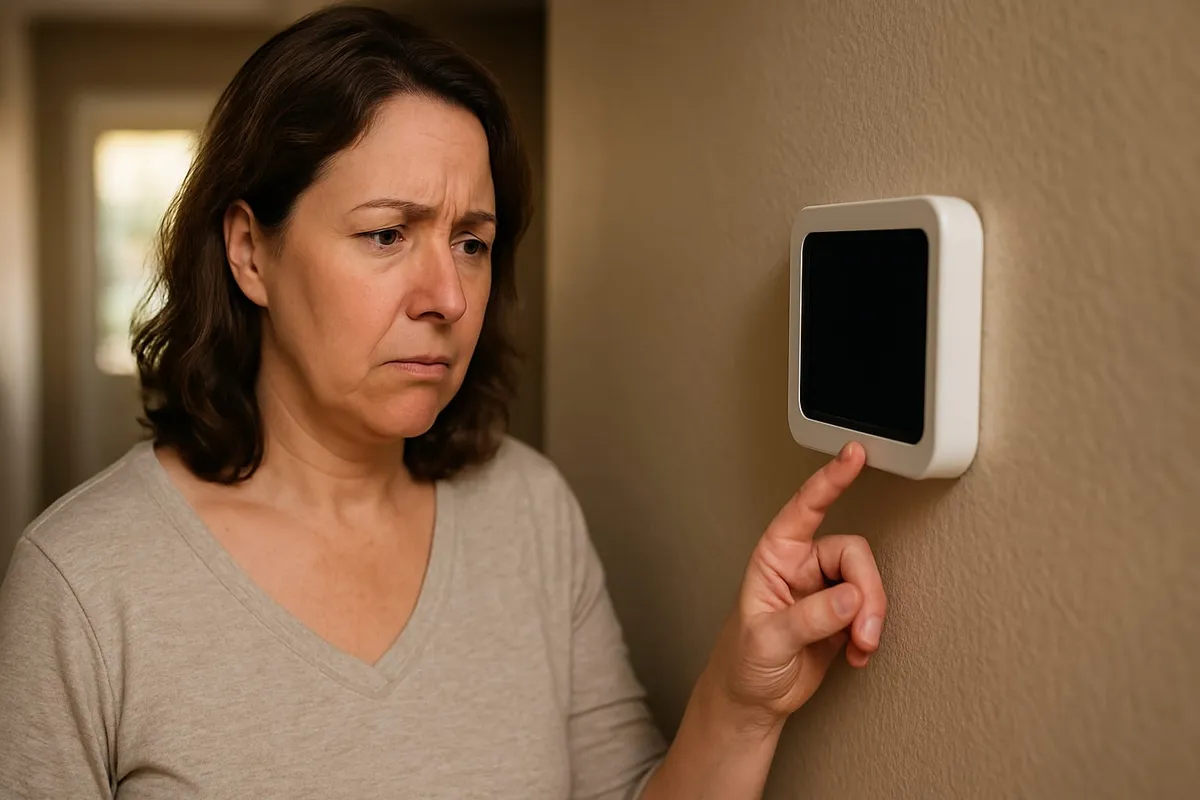
Your thermostat is the brain of your entire heating and cooling system. When it stops working — whether the screen goes blank, the system does not respond to temperature changes, or the heating and cooling cycles seem random — your comfort depends on diagnosing the issue quickly. Thermostat problems are behind a significant percentage of HVAC service calls, and many of them turn out to be simple fixes like dead batteries or a tripped breaker. This guide covers troubleshooting for every thermostat type, including battery-powered models, hardwired (24-volt) thermostats, programmable thermostats, and smart thermostats like Nest, Ecobee, and Honeywell Home. Whether your thermostat screen is blank, the display is on but your system is not responding, or the temperature readings seem wrong, this guide will help you pinpoint the problem.
Quick Fix Checklist
These five checks address the most common thermostat issues and take only a few minutes:
- Replace the batteries — If your thermostat uses batteries (most do), swap them with fresh alkaline AA or AAA batteries. This is the number one cause of a blank thermostat screen.
- Check the circuit breaker — Locate the HVAC breaker in your electrical panel. If it has tripped, reset it by flipping it fully off, then back on.
- Verify the settings — Confirm the mode (Heat or Cool) matches the season, the set temperature is at least 5 degrees above or below room temperature, and the fan is set to “Auto.”
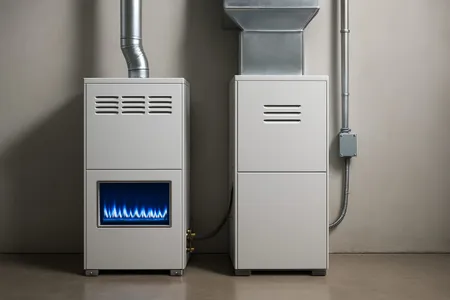
- Check the furnace power switch — Look for a light switch on or near your HVAC equipment. If someone accidentally flipped it off, the thermostat may lose its 24-volt power supply.
- Wait 5 minutes — Most thermostats have a built-in delay of 3 to 5 minutes between cycles to protect the compressor. If you just changed a setting, wait before assuming there is a problem.
1. Blank Thermostat Screen — Dead Batteries
What It Is and Why It Happens
The most common reason for a blank thermostat screen is dead or depleted batteries. Most modern thermostats use AA or AAA batteries either as their primary power source or as a backup to maintain settings during power outages. Batteries typically last 8 to 12 months, and most thermostats display a low-battery warning a month or two before they die completely. Once the batteries are dead, the display goes blank and the thermostat cannot send signals to your HVAC system.
How to Check
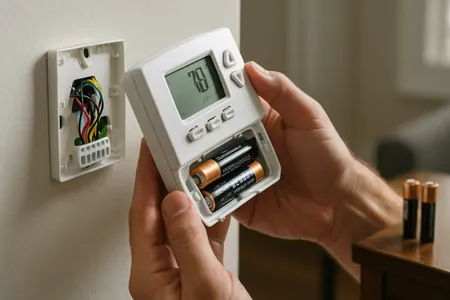
Look at the thermostat. If the screen is completely blank with no display at all, batteries are the most likely cause. Some thermostats have a battery compartment on the face, while others require you to pull the thermostat body off the wall plate to access the battery compartment.
How to Fix
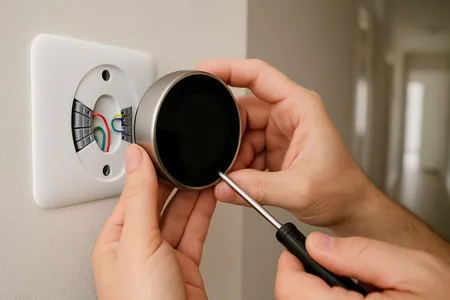
- Remove the thermostat from the wall plate (most models pull straight off or swing open).
- Locate the battery compartment.
- Remove the old batteries and insert fresh alkaline batteries (AA or AAA as required). Do not use rechargeable batteries — their lower voltage (1.2V versus 1.5V) can cause erratic behavior.
- Reattach the thermostat to the wall plate.
- The display should power on within a few seconds. You may need to reprogram the time, date, and schedule.
Estimated cost: A few dollars for batteries (DIY fix).
2. Blank Screen — Tripped Breaker or Power Loss
What It Is and Why It Happens
Hardwired thermostats (and smart thermostats that use a C-wire for constant power) get their electricity from the HVAC system’s 24-volt transformer. If the circuit breaker for your HVAC system trips, the transformer loses power and the thermostat screen goes blank. Breakers can trip during power surges, storms, or if there is an electrical issue within the HVAC equipment. The furnace or air handler may also have its own power switch that could be accidentally turned off.
How to Check
Go to your home’s electrical panel and find the breaker labeled “HVAC,” “Furnace,” or “Air Handler.” If it is in the middle position (tripped), it needs to be reset. Also check for a power switch on or near the furnace or air handler — it looks like a standard light switch and is easy to bump accidentally.
How to Fix
Reset the breaker by flipping it fully to the “Off” position, then back to “On.” Turn on the furnace power switch if it was off. Wait 1 to 2 minutes for the thermostat to power up. If the breaker trips again immediately, do not keep resetting it — this indicates an electrical fault in the HVAC system that requires professional attention.
Estimated cost: Free (DIY fix). If an electrical repair is needed, a technician can diagnose and quote it on site.
3. Blank Screen — Blown HVAC Fuse
What It Is and Why It Happens
Inside your furnace or air handler, the control board has a small, low-voltage fuse (typically a 3-amp or 5-amp automotive-style fuse) that protects the 24-volt circuit powering the thermostat. This fuse can blow due to a wiring short, a faulty thermostat installation, or a component failure in the HVAC system. When this fuse blows, the thermostat loses power even though the circuit breaker is fine.
How to Check
Turn off the power to the HVAC system. Open the furnace or air handler access panel and locate the control board. Look for a small glass or blade-type fuse, usually labeled “3A” or “5A.” If the fuse appears dark or the internal wire is broken, it has blown. You can also test the fuse with a multimeter set to continuity.
How to Fix
Replace the blown fuse with one of the exact same type and amperage rating. Fuses are available at hardware stores for just a few dollars. If the new fuse blows immediately after restoring power, there is a short circuit somewhere in the thermostat wiring or HVAC system. Call a professional to locate and repair the short.
Important: A blown fuse is a symptom, not the root cause. If the fuse blows repeatedly, there is an underlying electrical issue that must be found and fixed.
Estimated cost: A few dollars for a fuse (DIY fix). Professional diagnosis of a short circuit starts with our $100 service call, credited toward the repair only if it’s completed on that same visit; further electrical tracing is billed at $100–$150 an hour. These prices may vary case by case.
4. Thermostat Display Is On but System Does Not Respond
What It Is and Why It Happens
If the thermostat display is working and shows the correct settings but the HVAC system does not start when it should, the issue may be with the thermostat’s wiring connections, the HVAC equipment, or the thermostat itself. Loose wire connections at the thermostat terminals are a common culprit, especially in older homes where the wiring has been disturbed. A malfunctioning thermostat relay can also prevent the signal from reaching the equipment.
How to Check
- Raise the temperature setting to 80 degrees (if testing heat) or lower it to 60 degrees (if testing cooling) to force the system to call for conditioning.
- Listen for a click from the thermostat when you adjust the temperature past the current room temperature. If you hear no click, the thermostat may not be sending a signal.
- Check if the thermostat displays any error codes or alerts.
- If you are comfortable with basic electrical work, turn off the HVAC power, remove the thermostat from the wall plate, and check that all wires are securely connected to the correct terminals (R, W, Y, G, C).
How to Fix
For loose wires: Turn off the HVAC power. Remove the thermostat and ensure each wire is stripped about 1/4 inch and firmly secured in the correct terminal. Reattach the thermostat and restore power.
For a thermostat test: Turn off the HVAC power. Remove the thermostat and carefully touch the R (red) wire to the W (white) wire for heat, or R to Y (yellow) wire for cooling. Restore power briefly. If the system starts, the thermostat itself is faulty and needs replacement. If the system does not start, the problem is in the HVAC equipment, not the thermostat.
Safety Warning: Only perform the wire test if you are comfortable with low-voltage wiring. While 24 volts is not dangerous, incorrect connections can blow the HVAC fuse or damage the control board.
Estimated cost: Free for reconnecting wires. A new thermostat runs $110–$375 for the unit, plus labour at $100–$150 an hour for professional installation. These prices may vary case by case.
5. Thermostat Shows Wrong Temperature
What It Is and Why It Happens
If your thermostat displays a room temperature that seems inaccurate (the house feels cold but the thermostat says it is 72 degrees, for example), the thermostat’s built-in temperature sensor may be malfunctioning, or the thermostat may be installed in a poor location. Thermostats placed in direct sunlight, near heat-producing appliances, on exterior walls, near supply vents, or in drafty areas will give inaccurate readings. An older thermostat’s sensor may simply have drifted with age.
How to Check
Place an accurate standalone thermometer next to the thermostat and wait 15 minutes. Compare the readings. If they differ by more than 3 degrees Fahrenheit, there is a calibration or sensor issue. Also evaluate the thermostat’s location — it should be on an interior wall, about 5 feet off the floor, away from direct sunlight, heat sources, supply vents, and exterior doors.
How to Fix
For location issues: The only real fix is to relocate the thermostat to a better spot. This requires running new thermostat wire, which is a job for a professional.
For calibration issues on older mechanical thermostats: Some older models have a small calibration lever or screw behind the cover that allows adjustment. Consult your thermostat manual.
For digital thermostats with inaccurate readings: If the sensor has failed, replacing the thermostat is usually more cost-effective than attempting a repair. Modern digital thermostats are accurate to within 1 degree Fahrenheit.
Estimated cost: A new thermostat runs $110–$375 for the unit, plus labour at $100–$150 an hour. Relocating a thermostat is a labour job — ask for a quote when you call.
6. Smart Thermostat Not Connecting or Responding
What It Is and Why It Happens
Smart thermostats (Nest, Ecobee, Honeywell Home, etc.) add complexity because they rely on Wi-Fi connectivity, software updates, and cloud services in addition to the basic wiring and power that all thermostats need. Common issues include Wi-Fi disconnections, software bugs after updates, drained internal batteries (Nest thermostats have an internal rechargeable battery that can fail to charge if the C-wire is missing or the HVAC system is not providing enough power), and compatibility issues with certain HVAC systems.
How to Check
- Wi-Fi issues: Check if other devices in your home are connected to Wi-Fi. On the thermostat, navigate to the Wi-Fi settings and verify it is connected to the correct network.
- Nest battery issues: Go to Settings and check the battery voltage. It should read 3.6V or higher. Below 3.6V indicates a charging problem.
- Software issues: Check for pending software updates on the thermostat or in the companion app.
- Unresponsive screen: Try pressing or holding the main button for 10 seconds for a forced restart. For Nest, pull the display off the base and reattach it.
How to Fix
For Wi-Fi issues: Restart your router and the thermostat. Forget the network on the thermostat and reconnect with the current password. Move the router closer if signal strength is weak, or add a Wi-Fi extender.
For Nest battery issues: If the Nest battery is not charging, the most reliable fix is to install a C-wire (common wire) to provide constant 24-volt power. Without a C-wire, the Nest relies on stealing small amounts of power from other wires, which can cause cycling and battery drain issues. A C-wire adapter kit is an inexpensive part.
For unresponsive smart thermostats: Perform a restart by removing the thermostat from the wall plate, waiting 30 seconds, and reattaching it. If that does not work, perform a factory reset (check your manual for the specific procedure, as this erases all settings and schedules).
Estimated cost: Free for a restart. C-wire installation is a labour job a technician can quote on site. A new thermostat runs $110–$375 for the unit plus labour at $100–$150 an hour, installed. These prices may vary case by case.
7. Thermostat Short Cycling the HVAC System
What It Is and Why It Happens
Short cycling is when the HVAC system turns on and off in rapid succession, running for only a few minutes before shutting down and restarting. This is hard on equipment, wastes energy, and often fails to adequately heat or cool the home. Thermostat-related causes include poor thermostat placement (receiving heat from a nearby source or cold drafts), a failing thermostat sensor, or an anticipator setting that is incorrect (on older mechanical thermostats).
How to Check
Observe the system’s behavior. If the furnace or AC runs for less than 5 minutes before shutting off, then restarts within a few minutes, it is short cycling. Note whether the thermostat temperature reading changes rapidly — if it does, the sensor may be affected by drafts or heat sources.
How to Fix
Check the thermostat location — If it is near a supply vent, in direct sunlight, or above a heat-producing appliance, the temperature reading may spike artificially, causing the system to shut off prematurely. Relocating the thermostat may be necessary.
Check the air filter — A severely clogged filter can cause the furnace to overheat and short cycle. Replace the filter if it is dirty.
For older mechanical thermostats — Adjust the heat anticipator (a small sliding lever on the thermostat’s internal mechanism). Moving it slightly toward the “longer” setting can reduce short cycling.
If the problem persists after these checks, the issue may be with the HVAC equipment itself (oversized system, failing component) rather than the thermostat. Call a professional for a complete system evaluation.
Estimated cost: Varies depending on the cause. Filter replacement is inexpensive. Relocating the thermostat is a labour job a technician can quote on site.
When to Call a Professional
Contact an HVAC technician if:
- The thermostat screen remains blank after replacing batteries and checking the breaker — There may be a wiring issue or a blown low-voltage fuse in the HVAC system.
- The HVAC fuse blows repeatedly — A short circuit in the thermostat wiring or HVAC equipment needs professional diagnosis.
- You need to install or relocate a thermostat — Running new thermostat wire, identifying correct wiring connections, and ensuring compatibility all benefit from professional expertise.
- Your smart thermostat is incompatible with your HVAC system — Some systems (especially older ones or those with millivolt controls) are not compatible with smart thermostats.
- The system short cycles despite a clean filter and correct thermostat placement — The problem may be with the equipment itself.
Visit our contact page or use our troubleshooter tool for guided help with your thermostat issue.
Prevention Tips
Keep your thermostat functioning reliably with these simple habits:
- Replace batteries annually — Do it on a set date (like when you change your clocks) even if the low-battery warning has not appeared yet.
- Keep the thermostat clean — Gently dust the exterior and use compressed air to blow dust out of the interior annually. Dust can interfere with sensors and mechanical components.
- Do not place heat-producing items near the thermostat — Lamps, TVs, appliances, and direct sunlight can all give the sensor false readings.
- Update smart thermostat software — Keep your smart thermostat’s firmware current. Updates often fix bugs and improve performance.
- Schedule annual HVAC maintenance — A technician will test thermostat operation, calibration, and wiring as part of a routine maintenance visit. Learn about our maintenance plans.
Frequently Asked Questions
Why is my thermostat screen blank?
The most common cause of a blank thermostat screen is dead batteries. Replace them with fresh alkaline AA or AAA batteries. If the thermostat does not use batteries (hardwired models), check the HVAC circuit breaker and the furnace power switch. Also check for a blown low-voltage fuse on the HVAC control board. If none of these steps work, the thermostat itself may have failed.
Why does my thermostat say one temperature but it feels different?
A thermostat may display an inaccurate temperature if it is placed in a poor location (near a supply vent, in direct sunlight, on an exterior wall, or near a heat source). The internal sensor may also be failing, especially on thermostats more than 10 years old. Place a standalone thermometer next to the thermostat to compare. If they differ by more than 3 degrees, consider replacing or relocating the thermostat.
Can a bad thermostat cause the AC or furnace not to work?
Yes. The thermostat is the component that tells the HVAC system when to turn on and off. A faulty thermostat can prevent the system from starting, cause short cycling, or result in the system running continuously. If your HVAC system is not responding, test the thermostat by carefully touching the R wire to the W (heat) or Y (cooling) wire at the thermostat terminals. If the system starts, the thermostat is the problem.
How long do thermostats last?
Manual and programmable thermostats typically last 10 to 15 years. Smart thermostats generally last 5 to 10 years, though software updates can extend or reduce their useful life depending on manufacturer support. If your thermostat is more than 10 years old and behaving erratically, replacement is recommended.
Should I upgrade to a smart thermostat?
Smart thermostats can reduce energy costs by 10 to 15 percent through learning your schedule, adjusting temperatures when you are away, and providing usage insights. They work best in homes with compatible HVAC systems and reliable Wi-Fi. However, they require a C-wire for optimal performance (or an adapter kit). If your existing thermostat works well and you do not need remote access or scheduling features, a basic programmable thermostat is a reliable and less expensive option.
A thermostat that is not working correctly can mimic much more serious HVAC problems. Before assuming your furnace or AC has failed, work through the thermostat troubleshooting steps in this guide. You may save yourself the cost of a service call.
Next Steps
If troubleshooting points to an aging system or a problem beyond the thermostat itself, these tools and guides can help:
- Find out how old your system is — Enter your serial number into our HVAC Age Decoder to see the manufacture date and whether your equipment is past its expected lifespan.
- Decide whether to repair or replace — A failing thermostat sometimes signals bigger system issues. Our Repair or Replace Calculator weighs age, repair cost, and efficiency to give you a clear recommendation.
- Try a reset first — Many thermostat problems are software glitches that a reset can fix in minutes. Follow our step-by-step guide on how to reset any thermostat.
- Budget for a new thermostat — If replacement is the best path, our thermostat installation cost guide covers pricing for every model and wiring scenario.
- Ready to talk? — Contact us for a free evaluation.
If you are in Central Texas, Texas Temp Masters can diagnose and repair any thermostat issue. Call (817) 704-0706 or contact us online for fast scheduling.