Getting the right size AC for your Texas home is the single most important decision you’ll make when buying a new system. An oversized system wastes energy and fails to dehumidify. An undersized system runs constantly and can’t keep up on the hottest days.
Quick Answer: AC Size by Square Footage (Central Texas)
| Home Size | Recommended Tonnage | BTU/hr |
|---|---|---|
| 800-1,000 sq ft | 1.5-2 tons | 18,000-24,000 |
| 1,000-1,300 sq ft | 2-2.5 tons | 24,000-30,000 |
| 1,300-1,600 sq ft | 2.5-3 tons | 30,000-36,000 |
| 1,600-2,000 sq ft | 3-3.5 tons | 36,000-42,000 |
| 2,000-2,400 sq ft | 3.5-4 tons | 42,000-48,000 |
| 2,400-3,000 sq ft | 4-5 tons | 48,000-60,000 |
| 3,000+ sq ft | 5+ tons or dual system | 60,000+ |
Important: These are rough estimates for Central Texas. Your actual needs depend on insulation, windows, ceiling height, attic ductwork, and sun exposure. Use our free BTU Calculator for a more accurate estimate.
Why Correct Sizing Matters in Texas
The Oversizing Problem
Studies show the average Texas home is oversized by 35-50%. This is the #1 HVAC installation mistake and it causes serious problems:
- Short cycling — The system turns on and off every few minutes instead of running long, efficient cycles
- Poor humidity control — Short cycles don’t run long enough to remove humidity from the air. Your home feels cold and clammy at 72°F
- Higher energy bills — Starting the compressor uses more energy than running it. Frequent starts waste electricity
- Faster wear — The constant start-stop cycle stresses the compressor, reducing system lifespan by 3-5 years
- Uneven temperatures — Short blasts of cold air create hot and cold spots throughout the house
The Undersizing Problem
An undersized system causes different issues:
- Can’t reach setpoint — The system runs all day but can’t cool below 78-80°F on the hottest days
- Constant running — The compressor never gets a break, accelerating wear
- Higher bills — Continuous operation uses more total energy than properly-sized cycles
- Reduced lifespan — Non-stop operation burns out compressors faster
Factors That Affect Sizing in Texas
1. Home Age and Insulation
Older homes (pre-1980) typically have poor insulation and air sealing, requiring up to 30% more cooling capacity than newer homes. Key considerations:
- Attic insulation: R-30 or better is recommended for Texas. Many older homes have R-13 or less
- Wall insulation: Pre-1970 homes may have no wall insulation at all
- Air sealing: Gaps around windows, doors, and penetrations allow hot air infiltration
2. Attic Ductwork
Most Texas homes run ductwork through unconditioned attics that reach 130-150°F in summer. This adds roughly 20% to system needs. If your ducts are in the attic:
- Duct insulation should be R-8 minimum (many homes have R-4 or uninsulated)
- Duct leakage wastes 20-40% of conditioned air in poorly sealed systems
- Consider duct sealing and insulation as part of any system replacement
3. Windows and Sun Exposure
- Single-pane windows let in dramatically more heat than double-pane low-E
- West-facing windows receive the most intense afternoon heat
- No overhangs or shade means direct solar heat gain through glass all day
4. Ceiling Height
Standard sizing assumes 8-foot ceilings. Homes with 9, 10, or 12-foot ceilings have significantly more volume to cool:
- 9-foot ceilings: Add ~12% to capacity needs
- 10-foot ceilings: Add ~25%
- 12-foot ceilings: Add ~50%
5. Number of Occupants
Each person adds approximately 600 BTU/hr of heat. A family of 5 adds 3,000 BTU/hr to the cooling load — equivalent to a small space heater running all day.
Manual J: The Only Accurate Method
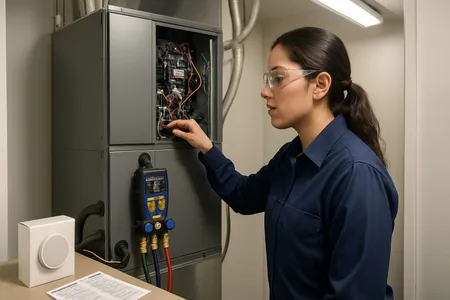
A Manual J load calculation is the only code-compliant method for sizing HVAC systems. Texas building code requires it for new installations. Manual J considers 30+ factors including:
- Exact insulation R-values for each wall, ceiling, and floor
- Window sizes, types, orientations, and shading
- Air infiltration rates (measured with a blower door test)
- Internal heat gains from appliances, people, and lighting
- Duct location, insulation, and leakage rates
- Local design temperatures (99-101°F for Central Texas)
Our BTU Calculator provides a useful estimate based on industry guidelines, typically within 15-20% of a professional Manual J calculation.
Two-Story and Large Home Considerations
Homes over 2,500 sq ft or with two stories often need dual-zone systems (two separate AC units) rather than one large unit:
- Upstairs/downstairs zoning — Heat rises, making upstairs consistently warmer. Two systems allow independent temperature control
- Better humidity control — Two properly-sized systems dehumidify better than one oversized system
- Redundancy — If one system fails, the other keeps part of the house comfortable
Getting It Right
- Use our calculator — Start with our free BTU Calculator for an initial estimate
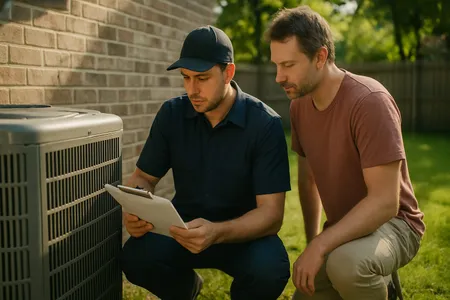
- Get a professional assessment — Contact us for a free in-home evaluation and professional Manual J calculation
- Don’t let contractors shortcut sizing — Any contractor who sizes your system based only on square footage is doing it wrong
- Consider your plans — If you’re planning to add insulation, replace windows, or finish an attic, factor those improvements into your sizing
Frequently Asked Questions
What size AC do I need for a 2,000 sq ft house in Texas?
Most 2,000 sq ft homes in Central Texas need a 3.5-4 ton system. However, the exact size depends on your home’s insulation, windows, ceiling height, and ductwork condition. A well-insulated newer home might need only 3 tons, while a poorly insulated older home could need 4.5 tons.
Can I put a bigger AC in to cool my house faster?
No — oversizing is the worst thing you can do. A bigger AC cools the air faster but shuts off before removing humidity, leaving your home feeling cold and clammy. It also wastes energy and wears out faster. Always size based on a load calculation, not a desire for “extra cooling.”
How many square feet does a 3-ton AC cover in Texas?
In Central Texas, a 3-ton AC typically handles 1,300-1,800 square feet depending on insulation quality, home age, and other factors. Well-insulated newer homes can push the upper end; older homes with poor insulation need more capacity per square foot.
Should I get the same size as my current system?
Not necessarily. Your current system may have been incorrectly sized. If you experience short cycling, humidity problems, or rooms that won’t cool, your current system is likely oversized. A proper Manual J calculation is the only way to determine the correct size.
Next Steps
Now that you understand AC sizing, put that knowledge to work:
- Find your perfect size — Use our free BTU Calculator to get a personalized tonnage recommendation for your home in under 2 minutes.
- See what it’ll cost — Our HVAC Cost Estimator shows Good/Better/Best pricing tiers with financing options so there are no surprises.
- Compare top brands — Not sure which brand to go with? Read our breakdown of the Best HVAC Brands for Texas Homes to see how Carrier, Trane, Lennox, and others stack up.
- Understand efficiency ratings — The size is only half the equation. Learn what SEER vs SEER2 means for your energy bills before you buy.
- Ready to talk? — Contact us for a free in-home evaluation with a professional Manual J load calculation.