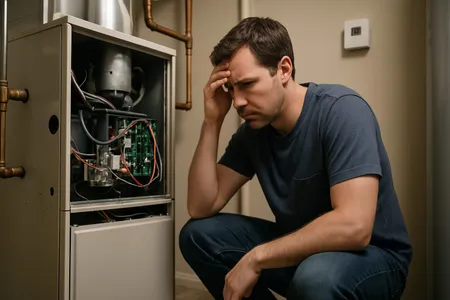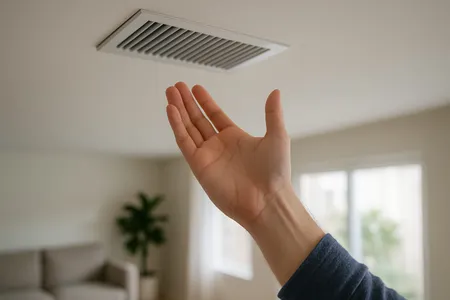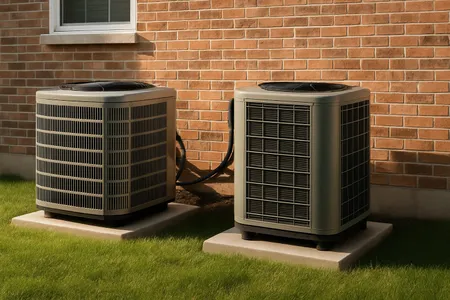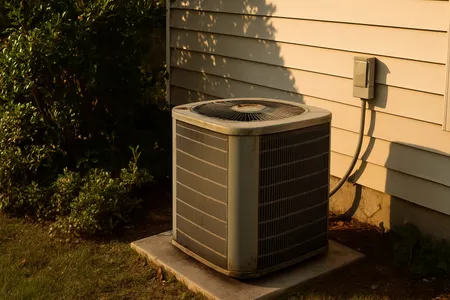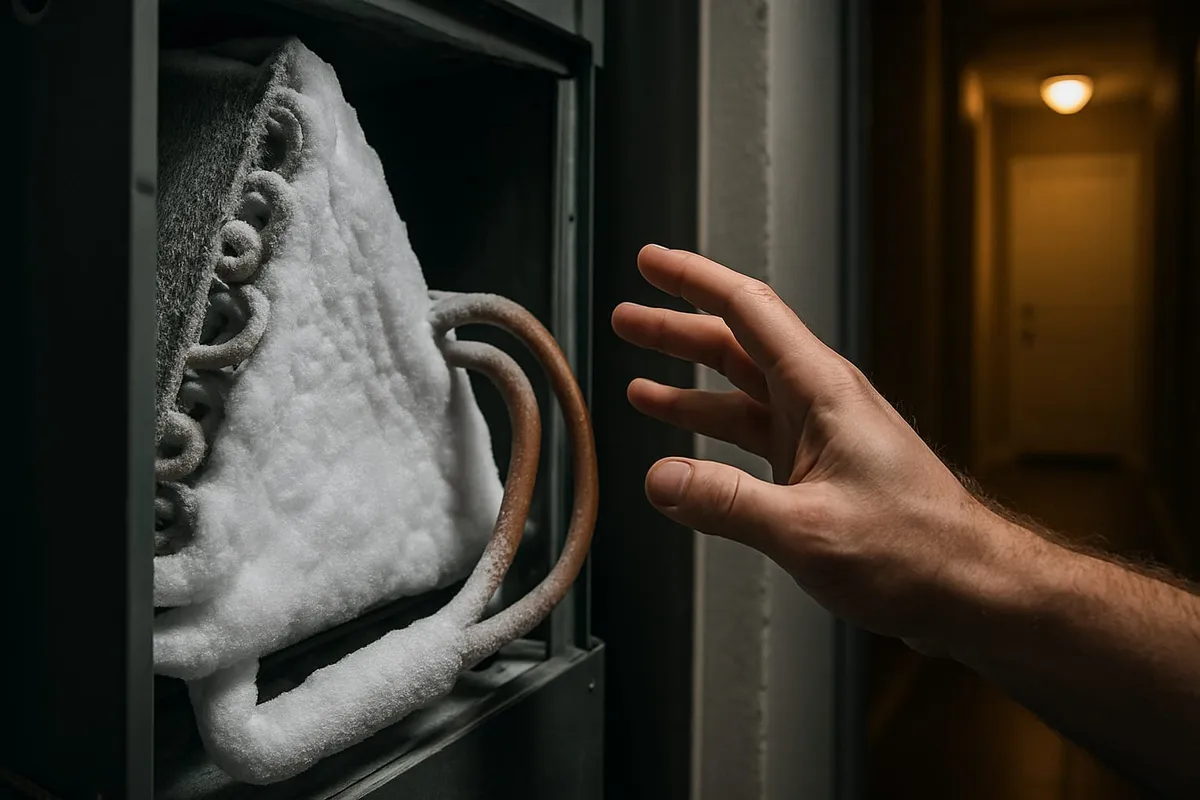
Your AC freezes up because the evaporator coil has dropped below 32°F, and the two causes behind almost every case are restricted airflow (usually a dirty air filter) or low refrigerant from a leak. Turn the system from “Cool” to “Off,” set the fan to “On” to thaw the coil, and check the filter — if the filter is dirty and ice does not return after you replace it, you have fixed it yourself for the price of a new filter. If ice comes back with a clean filter, you likely have a refrigerant leak and need a technician. The rest of this guide covers every cause, in order of likelihood, with what each fix costs.
Which cause do I have?
| What you observe | Most likely cause |
|---|---|
| Filter is visibly dirty | Restricted airflow — replace filter |
| Ice returns after a new filter and open vents | Refrigerant leak — call a pro |
| Hissing/bubbling sound; ice on the outside line | Refrigerant leak — call a pro |
| Froze overnight during a cool spell | Outdoor temp below ~60°F |
| Weak air from vents even with a clean filter | Blower or dirty coil — call a pro |
| System never cycles off | Thermostat fault |
Quick Fix Checklist
If you notice ice on your AC unit right now, take these immediate steps:
- Turn off the cooling — Switch your thermostat from “Cool” to “Off” immediately. Continuing to run a frozen system can severely damage the compressor.
- Set the fan to “On” — Keep the fan running to blow warm air over the frozen coil and speed up thawing. This is faster and safer than waiting for the ice to melt on its own.
- Check the air filter — If the filter is dirty, replace it immediately. A clogged filter is the most common cause of AC freeze-ups.
- Open all supply vents — Walk through your home and make sure every vent is open and not blocked by furniture, curtains, or rugs.
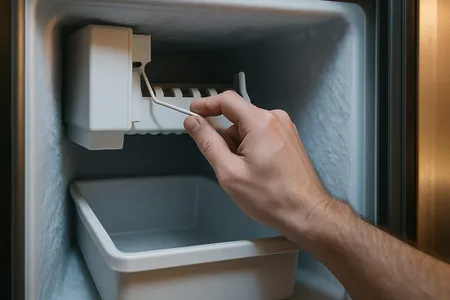
- Wait for complete thawing — Do not turn the cooling back on until all ice has melted, which can take 2 to 24 hours depending on severity. Place towels around the air handler to catch meltwater.
Warning: Do not chip, scrape, or pick at the ice on the coil. This can puncture the copper refrigerant tubing and cause a leak that is expensive to repair.
1. Restricted Airflow from a Dirty Air Filter
What It Is and Why It Happens
Your evaporator coil works by absorbing heat from the air that passes over it. The refrigerant inside the coil is extremely cold (typically around 40 degrees Fahrenheit), and it relies on a continuous stream of warm indoor air flowing across it to keep the coil surface above freezing. When a dirty air filter restricts airflow, not enough warm air reaches the coil. The coil temperature drops below 32 degrees Fahrenheit, and moisture from the air freezes on the coil surface. As ice accumulates, it further reduces airflow, creating a cycle that makes the problem progressively worse.
How to Check
Remove the air filter and inspect it. If it is dark gray, heavily coated with dust, or you cannot see light through it, it is overdue for replacement. Even a filter that looks moderately dirty can reduce airflow enough to cause freezing during high-demand conditions.
How to Fix
Replace the filter with a new one of the correct size. After the coil has fully thawed and the new filter is in place, turn the system back to “Cool” and monitor it closely for the next hour. If no new ice forms, the problem is solved. Going forward, check the filter monthly and replace it every 30 to 90 days depending on household factors (pets, allergies, construction activity).
Estimated cost: A replacement filter is inexpensive and widely available at hardware and home stores (DIY fix).
2. Blocked or Closed Supply Vents
What It Is and Why It Happens
When supply vents are closed or blocked by furniture, the cooled air has nowhere to go and airflow through the system drops. This has the same effect as a dirty filter — reduced airflow causes the evaporator coil to get too cold, and ice begins to form. Homeowners sometimes close vents in unused rooms thinking it will save energy, but this actually increases pressure in the ductwork and reduces overall system airflow, creating conditions that lead to freezing.
How to Check
Walk through every room in your home and check each supply vent. Make sure the louvers are open and that no furniture, rugs, curtains, or other objects are blocking the vents. Also check return air vents (where air is pulled back into the system) for obstructions.
How to Fix
Open all vents that are closed. Rearrange furniture to provide at least 6 inches of clearance around every vent. As a rule, never close more than 20 percent of the vents in your home. If you want to redirect airflow to specific rooms, talk to an HVAC professional about zone dampers rather than closing vents.
Estimated cost: Free (DIY fix).
3. Low Refrigerant from a Leak
What It Is and Why It Happens
Refrigerant circulates through your AC system in a sealed loop and should never need topping off under normal conditions. If the refrigerant level is low, it means there is a leak somewhere in the system — typically at a corroded coil joint, a damaged line set, a faulty Schrader valve, or a cracked evaporator coil. When refrigerant levels drop, the pressure inside the evaporator coil decreases, which causes the coil temperature to drop well below freezing. Ice forms on the coil and spreads along the refrigerant lines. This is one of the most common causes of AC freeze-ups that does not go away after thawing.
How to Check
After fully thawing the system and replacing the air filter, turn the AC back on. If ice begins to form again within a few hours, low refrigerant is a strong possibility. Other signs include:
- A hissing or bubbling sound near the indoor or outdoor unit
- The AC runs continuously but never reaches the set temperature
- Ice forms on the outdoor refrigerant line (the larger, insulated copper pipe)
- Electric bills are unusually high
How to Fix
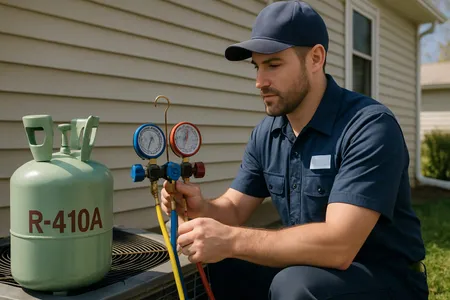
Call a professional. Handling refrigerant requires EPA Section 608 certification by law. A technician will use gauges to measure refrigerant pressure, perform a leak search using electronic detectors or UV dye, repair the leak, and recharge the system with the correct type and amount of refrigerant. Simply adding refrigerant without finding and fixing the leak is a temporary measure — the refrigerant will leak out again.
Estimated cost: Refrigerant is billed by the pound, and the leak has to be found and repaired before recharging is worthwhile — a technician can give you an itemized quote once they know how much refrigerant your system needs. If the evaporator coil itself is leaking, replacement costs more than a leak repair; ask for a written quote once the tech has inspected it.
4. Dirty Evaporator Coil
What It Is and Why It Happens
Even with regular filter changes, the evaporator coil accumulates a thin layer of dust and dirt over the years. This layer of grime acts as insulation on the coil surface, reducing heat absorption and causing the coil to run colder than it should. When combined with other factors (a slightly dirty filter, partially closed vents), a dirty evaporator coil can tip the balance toward freezing. In severe cases, the buildup is enough to cause freezing on its own.
How to Check
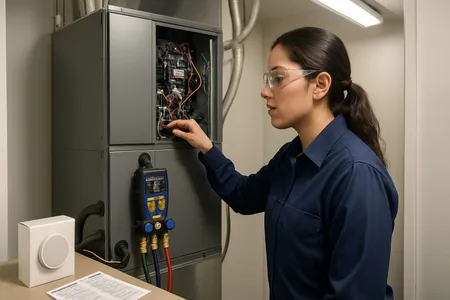
Turn off the system and remove the air handler access panel. Shine a flashlight on the evaporator coil. If you can see a visible layer of dirt, dust, or grime on the coil fins, it needs cleaning. Keep in mind that even a thin film that is hard to see can reduce efficiency.
How to Fix
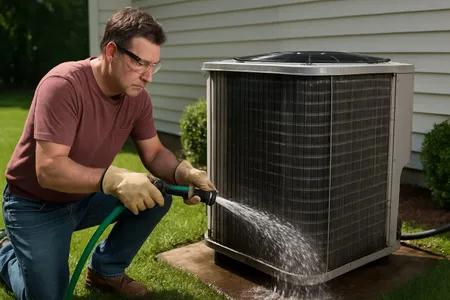
Light surface dust can be removed carefully with a soft brush. For more thorough cleaning, apply a no-rinse evaporator coil cleaner (available at hardware stores) following the product instructions. Spray the cleaner on the coil, let it foam and drip into the drain pan, and allow it to dry.
For heavily soiled coils, call a professional for a deep cleaning. A technician can access both sides of the coil and clean it thoroughly without risking damage.
Estimated cost: A DIY coil cleaner is inexpensive and available at hardware stores. Professional evaporator coil cleaning costs more — ask your technician for a quote based on the coil’s condition.
5. Blower Fan Problems
What It Is and Why It Happens
The blower fan (located inside the air handler) is responsible for pulling warm air from your home through the return ducts, across the evaporator coil, and back out through the supply ducts. If the blower fan is not working properly — running at reduced speed, intermittently stopping, or not running at all — airflow across the coil drops and ice can form. Common causes of blower fan problems include a failing fan motor, a worn or broken fan belt (in older belt-drive systems), a dirty blower wheel (accumulated dust throws the wheel off balance), or a bad capacitor.
How to Check
Stand near a supply vent while the system is in cooling mode. You should feel strong, steady airflow. If the airflow is noticeably weak or inconsistent, the blower may not be operating at full capacity. Also listen for unusual sounds from the air handler: a squealing noise suggests a belt or bearing issue, while a humming without air movement suggests a motor or capacitor problem.
How to Fix
Check the air filter first (a severely clogged filter can make it seem like the blower is weak). If the filter is clean and airflow is still poor, call a professional to inspect the blower motor, capacitor, and blower wheel. Blower motors have high-voltage electrical connections that are dangerous to work with.
Estimated cost: A capacitor is the cheaper of the two fixes — part $150–$375, plus about half an hour of labor at $100–$150/hour, for an estimated total of $200–$450. A blower motor replacement costs more: part $300–$450, plus 1 to 3 hours of labor at $100–$150/hour, for an estimated total of roughly $400–$900. Either repair credits the $100 service call toward the bill when it’s completed on that same visit. These prices may vary case by case.
6. Running the AC When It Is Too Cold Outside
What It Is and Why It Happens
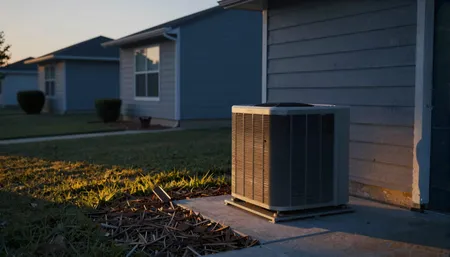
Air conditioning systems are designed to operate when outdoor temperatures are above approximately 60 degrees Fahrenheit. When outdoor temperatures drop below this threshold, the refrigerant pressure in the system decreases and the evaporator coil temperature drops below freezing. This is why you may wake up to a frozen AC in the spring or fall when nighttime temperatures dip while the AC ran overnight. The system does not have a built-in mechanism to prevent this in most standard units (some newer systems have a low-ambient sensor that shuts off the compressor).
How to Check
Check the overnight low temperatures. If the outdoor temperature dropped below 60 degrees Fahrenheit while the AC was running, this is the likely cause of the freeze-up.
How to Fix
Allow the system to thaw completely, then turn it back on once outdoor temperatures rise above 60 degrees. For spring and fall nights when temperatures fluctuate, raise the thermostat set temperature at night or switch to “Fan Only” mode to avoid running the compressor when it is too cool outside. If you need cooling at outdoor temperatures below 60 degrees, consider opening windows instead of running the AC.
Estimated cost: Free (behavior change).
7. Malfunctioning Thermostat
What It Is and Why It Happens
A faulty thermostat can cause the AC to run continuously without cycling off, even after the set temperature is reached. If the compressor runs non-stop, the evaporator coil can become overcooled to the point where ice forms. This is especially likely to happen at night when indoor cooling demands are lower but the system keeps running because the thermostat is not sensing the correct temperature or is not sending the shutoff signal.
How to Check
Monitor the thermostat closely. If the room temperature displayed reaches or drops below the set temperature and the system does not turn off, the thermostat is likely malfunctioning. Also check if the thermostat is in direct sunlight or near a heat source, which could give it a false high reading and cause it to keep calling for cooling.
How to Fix
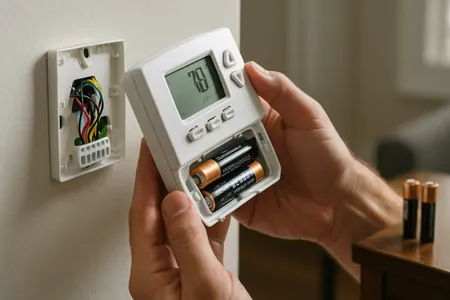
Try resetting the thermostat by removing it from the wall plate for 30 seconds, then reattaching it. Replace the batteries if applicable. If the system still runs continuously, the thermostat may need replacement. Refer to our complete thermostat troubleshooting guide for detailed steps.
Estimated cost: Batteries are inexpensive and available at any hardware store. If the thermostat itself needs replacing, the part runs $110–$375, plus labor at $100–$150 per hour. These prices may vary case by case.
When to Call a Professional
Call an HVAC technician if:
- Ice returns after thawing and replacing the air filter — This strongly suggests a refrigerant leak or a mechanical problem that will not resolve on its own.
- You hear hissing or bubbling sounds from the indoor or outdoor unit — These are signs of a refrigerant leak.
- The blower fan is not running or runs intermittently — Motor or capacitor failure requires professional repair.
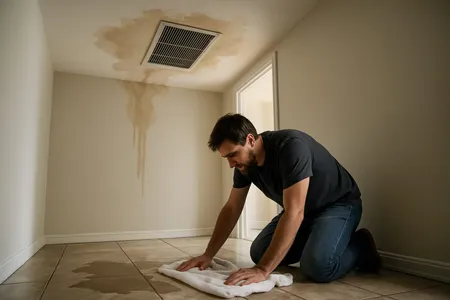
- The freeze-up has caused water damage — Significant ice melting can overflow drain pans and damage ceilings, walls, or floors.
- The system freezes up repeatedly despite clean filters and open vents — Recurring freeze-ups indicate an underlying issue that needs professional diagnosis.
Critical Warning: Never continue running a frozen AC in cooling mode. The compressor is designed to compress refrigerant gas, not liquid. When ice melts and liquid refrigerant returns to the compressor (called “slugging”), it can cause catastrophic compressor failure — the single most expensive AC repair, and one a technician can only quote after inspecting the damage.
For urgent cooling issues, visit our emergency HVAC repair page or contact us for fast diagnosis.
Prevention Tips
Prevent AC freeze-ups with these maintenance practices:
- Change the air filter every 30 to 90 days — This is the most effective prevention step. Set a reminder on your phone or calendar.
- Keep all supply and return vents open and unobstructed — Never close more than 20 percent of your home’s vents.
- Schedule annual AC maintenance — A professional tune-up includes checking refrigerant levels, cleaning coils, testing the blower motor, and verifying airflow. See our maintenance plans.
- Do not run the AC when outdoor temperatures are below 60 degrees Fahrenheit — Use fan-only mode or open windows during cool nights.
- Address unusual sounds or weak airflow immediately — Early signs of blower or refrigerant problems are easier and cheaper to fix before they cause a freeze-up.
Frequently Asked Questions
Will a frozen AC fix itself?
No. While the ice will eventually melt if you turn off the cooling and let the fan run, a frozen AC is a symptom of an underlying problem. If the root cause (dirty filter, low refrigerant, blocked vents, failing blower) is not addressed, the system will freeze up again as soon as it starts cooling. Always identify and fix the cause before restarting.
How long does it take for a frozen AC to thaw?
Thawing time depends on the severity of the ice buildup. A light frost may melt in 1 to 2 hours with the fan running. Heavy ice buildup on the coil and refrigerant lines can take 12 to 24 hours to thaw completely. Do not turn the cooling back on until all visible ice is gone and the drain pan has emptied.
Can low refrigerant cause an AC to freeze?
Yes. Low refrigerant is one of the most common causes of AC freeze-ups. When refrigerant levels drop due to a leak, the pressure inside the evaporator coil decreases, which causes the coil temperature to drop below freezing. Ice then forms on the coil surface. If your AC freezes up repeatedly despite a clean filter and open vents, a refrigerant leak is the most likely cause and requires professional repair.
How much does it cost to fix a frozen AC unit?
The cost depends on the cause. A dirty air filter is one of the cheapest fixes — inexpensive enough to replace yourself. If low refrigerant is the issue, the recharge and any leak repair add to the bill, and the total depends on how much refrigerant is needed and where the leak is. A blower motor replacement runs $300–$450 for the part, plus labor at $100–$150 per hour. Evaporator coil replacement is one of the more expensive repairs — a technician can quote the exact figure once they’ve inspected the unit. These prices may vary case by case.
Is it safe to run my AC after it freezes up?
You should never run the AC in cooling mode while ice is present. Wait for the system to thaw completely, address the underlying cause (replace the filter, verify vents are open), and then restart the cooling. If ice returns after restarting, turn the system off again and call a professional. Running a frozen system risks compressor damage, which is the most costly AC repair.
A frozen AC unit is always a sign of an underlying problem, not something to ignore. The sooner you identify and address the cause, the less likely you are to face expensive compressor damage. Start with the basics — filter and vents — and call a professional if the problem persists.
If you are in Central Texas and your AC has frozen up, Texas Temp Masters offers fast air conditioning service. Call (817) 704-0706 or contact us online for fast, expert diagnosis.
Next Steps
Now that you know why your AC is freezing up, here is how to take action:
- Diagnose the root cause — Run through our free HVAC Troubleshooter to pinpoint whether it is an airflow, refrigerant, or mechanical issue causing the freeze-up.
- Decide if it is worth repairing — If your system is older, use our Repair or Replace Calculator to see whether fixing the freeze-up makes financial sense or if it is time for a new unit.
- Estimate refrigerant costs — Suspect a leak? Our Refrigerant Cost Calculator shows what a recharge will cost based on your refrigerant type and system size.
- Still not getting cold air after thawing? — A freeze-up is not the only reason for weak cooling. Read our guide on AC Not Blowing Cold Air to rule out other causes.
- Ready for professional help? — Contact us to schedule a fast diagnostic visit with upfront pricing and no hidden fees.