Whether your air conditioner just gave out on the hottest day of summer or you are proactively planning a replacement, knowing what to expect cost-wise is essential for making an informed decision.
What Affects AC Replacement Costs in 2026
Replacing a central air conditioner is one of the larger investments a Texas homeowner makes in their home. The final price depends on your system’s size, efficiency rating, brand, and how much additional work — ductwork, electrical, permits — your installation requires. Because every home and system is different, the only way to get an accurate number is a written quote from a technician who has actually seen your setup. Call (817) 704-0706 for a free consultation, or keep reading for how each factor affects the price.
AC Replacement Cost by Unit Size
Air conditioner size is measured in tons (1 ton = 12,000 BTUs of cooling capacity). The right size depends on your home’s square footage, insulation, climate, and other factors.
Cost rises with tonnage — a larger system for a bigger home costs more in both equipment and installation than a smaller system for a smaller one. Because oversizing or undersizing hurts both comfort and efficiency, a technician should run a proper load calculation on your home rather than estimating from square footage alone. Ask for the recommended tonnage in writing along with your quote.
Cost by Efficiency Level (SEER2 Rating)
Higher efficiency systems cost more upfront but lower your monthly energy bills over time. In general, moving up from a standard efficiency tier toward a premium high-SEER2 system raises the installed price while lowering what you pay to run it each summer. To understand efficiency ratings better, read our guide on SEER vs SEER2 and what the numbers mean for your energy bills.
Cost by Brand
Pricing typically follows brand tier. Budget-friendly brands like Goodman and Amana cost less upfront; mid-range brands like Rheem, Ruud, and York land in the middle; and premium brands like Carrier, Trane, and Lennox cost more but often carry longer parts warranties. For a detailed breakdown of top brands, check out our Carrier vs Trane comparison.
Factors That Affect AC Replacement Cost
1. Refrigerant Transition
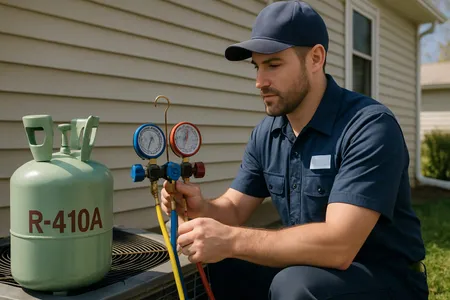
Starting in 2025, newly manufactured residential AC systems must use low-GWP refrigerants like R-454B (marketed as Puron Advance by Carrier). This transition has increased equipment prices by approximately 10% to 15% compared to older R-410A models. Units manufactured before the deadline using R-410A can still be installed through January 1, 2026. Learn more about this transition in our R-410A Phase Out Guide.
2. Ductwork Modifications
If your existing ductwork is undersized, leaking, or damaged, expect additional cost on top of the AC unit itself. The scope ranges widely — from sealing a few leaky joints, to replacing a section of duct, up to a full duct system for a home whose ductwork was never right to begin with. Your contractor can tell you which of these your home needs after an inspection, and should itemize duct work separately from the AC unit on your quote.
3. Electrical Upgrades
Older homes may need electrical panel upgrades or new wiring to support a modern AC unit. This adds to the overall project cost — ask your contractor to flag it during the initial site visit rather than as a surprise later.
4. Thermostat Upgrade
If you are replacing an older unit, upgrading to a smart thermostat at the same time is a smart move. See our Smart Thermostat Installation Cost guide for pricing.
5. Permits and Inspections
Most municipalities require a permit for HVAC replacement. The fee varies by city. Your contractor should handle the permit process and can tell you the cost for your area.
6. Removal and Disposal
Removing the old unit and properly disposing of the old refrigerant adds a modest cost, though many contractors include this in their quote rather than billing it separately.
7. Location and Access
Rooftop units, systems in tight attic spaces, or second-floor installations may cost more due to the additional labor involved.
8. Compressor Type
Single-stage, two-stage, and variable-speed compressors all perform differently and carry different price tags. Variable-speed systems cost 30% to 60% more than single-stage but offer superior comfort and efficiency.
DIY vs. Professional AC Replacement
Why DIY Is Not Recommended
Replacing an air conditioner is not a DIY project. Here is why:
- EPA certification required: Federal law (Section 608 of the Clean Air Act) requires EPA certification to handle refrigerants
- Warranty requirements: Manufacturers require professional installation for warranty coverage
- Electrical hazards: Working with 240-volt circuits poses serious safety risks
- Sizing mistakes: Improper sizing leads to poor performance, high bills, and early failure
- Code violations: Unpermitted work can create problems when selling your home
What You Can Do
- Remove landscaping or obstructions around the old outdoor unit to save labor time
- Research and compare quotes before selecting a contractor
- Arrange for clear access paths to the indoor and outdoor equipment
How to Save Money on AC Replacement
- Get at least three quotes: Pricing varies significantly between contractors for the same equipment
- Schedule in the off-season: Spring and fall installations may cost 5% to 15% less
- Ask about rebates: Utility companies and manufacturers often offer rebates on qualifying high-efficiency systems — ask your contractor or utility provider what’s currently available in your area
- Check tax credits: The federal 25C tax credit for qualifying high-efficiency heat pump systems expired December 31, 2025 under OBBBA — see our 2026 tax credits guide for what’s still available
- Bundle with a furnace: If your furnace is also aging, replacing both together in one project typically costs less than two separate jobs — ask your contractor for combined pricing
- Consider financing: Many HVAC contractors offer 0% interest financing for 12 to 60 months
- Skip unnecessary upgrades: A mid-tier SEER2 system offers strong efficiency without the premium price of the highest-efficiency models
Use our Cost Estimator Tool to get a personalized estimate based on your home’s specifics.
When to Repair vs. Replace Your AC
One common rule of thumb: multiply the age of your system, in years, by the cost of the repair. If that number is high relative to the cost of a new system, replacement is usually the better investment. Ask your technician to walk through this math using your actual repair quote.
Replace if:
- Your AC is 12 to 15+ years old
- The repair costs more than 50% of a new system
- Your system uses R-22 refrigerant (phased out; recharging costs $150 per pound for the refrigerant itself, plus labour — these prices may vary case by case)
- You have had multiple major repairs in the past 2 to 3 years
- Your energy bills have increased noticeably despite regular maintenance
Repair if:
- Your system is under 8 years old
- The issue is minor (capacitor, contactor, or fan motor replacement)
- The repair costs less than 30% of replacement
- No refrigerant leak issues
Visit our Repair or Replace Calculator to get a personalized recommendation.
Frequently Asked Questions
How long does it take to replace an AC unit?
A standard AC replacement takes 4 to 8 hours for a one-day installation. If ductwork modifications or electrical upgrades are needed, it could extend to 2 days.
How long does a new AC unit last?
A properly installed and maintained central AC unit lasts 15 to 20 years. Annual maintenance is the single best way to maximize lifespan.
Should I replace my AC and furnace at the same time?
If your furnace is more than 12 years old, replacing both together is usually the best value. Matched systems perform more efficiently and are covered under a single warranty. Read our full HVAC system cost guide for bundled pricing.
Will a new AC unit lower my electric bill?
Yes. Upgrading from an older 10 SEER system to a new 16 SEER2 unit can reduce cooling energy costs by 30% to 40%. Use our Energy Savings Calculator to estimate your potential savings.
Do I need to replace the indoor coil when replacing my AC?
In most cases, yes. Mismatching a new outdoor unit with an old indoor coil reduces efficiency and can void the manufacturer’s warranty. Most contractors include the evaporator coil in their replacement quotes.
In Central Texas? Texas Temp Masters specializes in AC replacement with transparent pricing and no hidden fees. We will help you choose the right system for your home and budget. Call (817) 704-0706 for a free consultation, or visit our Air Conditioning page to see the brands we carry.
Next Steps
Planning a replacement is a big decision — these resources can help you get it right:
- Size your new system — Use our BTU Calculator to find the right tonnage for your home’s square footage, insulation, and climate.
- Check your current system’s age — Enter your serial number into our HVAC Age Decoder to confirm whether your unit has reached the end of its useful life.
- Weigh repair first — Before committing to a full replacement, review average repair prices in our AC repair cost guide.
- Know your system’s expected lifespan — Our guide on how long an AC unit lasts breaks down longevity by brand and maintenance habits.
- Compare top brands for Texas — See which manufacturers hold up best in our climate in the best HVAC brands for Texas guide.
- Want the full picture? — Our Central Texas Homeowner’s HVAC Guide is the complete Central Texas homeowner’s guide, from symptoms through system choice.
- Ready to talk? — Contact us for a free evaluation.