The quickest honest answer is the $5,000 rule: multiply your AC’s age in years by the repair quote in dollars — if the result is over $5,000, replace; if it’s under, repair. A 12-year-old unit facing a $600 repair scores $7,200: replace. A 6-year-old unit facing a $400 repair scores $2,400: repair. Two Texas-specific overrides tilt the answer further toward replacement: systems that still use phased-out R-22 refrigerant, and the fact that Central Texas heat works ACs harder than the national average, so local systems age faster than the brochure says.
The $5,000 rule, and why it works
Age × repair cost > $5,000 → replace. The rule works because it captures both of the things that actually matter: how much life the repair is buying (less on an old unit) and how big the bet is (more on an expensive repair). It is a screening tool, not scripture — but when a quote fails the rule badly, spending big money on old equipment is almost always the wrong call.
| Your AC’s age | $250 repair | $600 repair | $1,500 repair |
|---|---|---|---|
| 5 years | Repair ($1,250) | Repair ($3,000) | Borderline ($7,500) |
| 10 years | Repair ($2,500) | Borderline ($6,000) | Replace ($15,000) |
| 15 years | Repair ($3,750) | Replace ($9,000) | Replace ($22,500) |
| 20 years | Borderline ($5,000) | Replace ($12,000) | Replace ($30,000) |
(“Borderline” means run the fuller numbers — warranty status, refrigerant type, efficiency gain — with the Repair or Replace Calculator.)
The three overrides that beat the rule
1. The R-22 override: replace
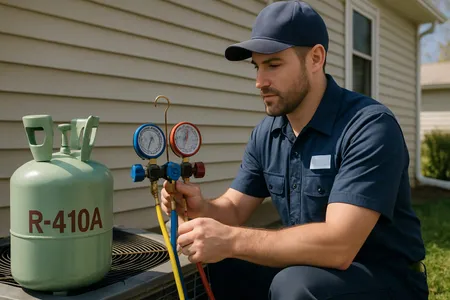
If your system was manufactured before roughly 2010, it likely runs R-22 refrigerant — banned from production since 2020 and now costing $150–$250 per pound. Any R-22 repair that involves refrigerant (leaks, coils, compressor) fights that price: a routine recharge can run $450–$1,250 in refrigerant alone, and the next leak starts the meter again. Once an R-22 system needs sealed-system work, replacement almost always wins regardless of the $5,000 math. Check what you have with the HVAC Age Decoder.
2. The warranty override: repair
Most systems carry 5–10-year parts warranties. If your part is covered, you pay labor only — typically $150–$500 — which transforms the math. A “$1,800 evaporator coil” that is actually a $450 labor-only warranty job on an 8-year-old unit is a clear repair. Always check warranty status before deciding; the serial number dates the unit (our serial-number guides show how).
3. The minor-repair override: repair
Capacitors ($150–$350), contactors ($100–$275), drain lines ($75–$250), thermostats ($100–$400): these are wear items, not verdicts on the system. Even on a 15-year-old unit, a $150 capacitor is a repair, the same way a battery doesn’t total a car. The rule is for major repairs — refrigerant circuits, coils, compressors, blowers.
What does replacement actually cost?
Central AC replacement in Central Texas typically runs $5,500–$9,000 installed for common home sizes, more for premium-efficiency equipment — see the full AC replacement cost guide. Two things soften the number: a new ENERGY STAR system can cut cooling costs 20–40% versus an aging unit (real money when the AC runs eight months a year here); the federal tax credit itself expired December 31, 2025, but other incentives may still apply. Get the itemized replacement quote before authorizing a borderline major repair — you cannot compare options you haven’t priced.
Signs the decision is already made
Replace-side signals:
- 15+ years old in Texas heat (systems here live at the hard end of the typical 15–20-year range — details)
- Second major repair in two years — the failures are telling you something
- R-22 system with any sealed-system fault
- Cooling bills climbing year over year with no usage change
- The house never gets comfortable even when “everything works”
Repair-side signals:
- Under 10 years old
- First major failure, parts under warranty
- The repair is a wear item (capacitor, contactor, motor, drain)
- The system cooled well right up until this failure
Frequently Asked Questions
Is it worth repairing a 15-year-old AC unit?
For minor wear items, yes. For major repairs — refrigerant leaks, coils, compressor — usually not: at 15 years the $5,000 rule fails at any repair over ~$333, the unit is at the end of its expected life in this climate, and it likely uses costly R-22. Price the replacement before authorizing major work.
What is the $5,000 rule for AC replacement?
Multiply the unit’s age in years by the repair cost in dollars. Over $5,000, replacement is generally the better investment; under, repair. Example: 12 years × $500 = $6,000 → replace.
How long should an AC last in Central Texas?
The national average is 15–20 years; Central Texas systems tend to land at the lower end of that range because of near-continuous summer duty. A well-maintained system reaching 15 here has done its job. More in How Long Does an AC Unit Last in Texas?
Should I replace my AC before it dies completely?
If it is 15+, R-22-based, or racking up repairs — yes, on your schedule rather than its own. A planned replacement lets you compare quotes and catch rebates. An emergency replacement happens during a July heat wave at whatever price and timeline is available.
Facing a big repair quote in Killeen, Copperas Cove, Temple, Belton, or Harker Heights? Texas Temp Masters gives you both numbers — the honest repair price and the itemized replacement quote — so the $5,000 rule is yours to run, not ours to hide. Call (817) 704-0706 or contact us online, or start with the Repair or Replace Calculator.