Mini split sales have surged over the past few years, and for good reason: they are efficient, flexible, and surprisingly affordable for single-room cooling. But central air conditioning still accounts for the vast majority of home cooling systems in the United States. The right choice depends on your home layout, budget, existing ductwork, and how you actually use your space.
This guide compares mini splits and central AC on every factor that matters so you can make a confident decision in 2026.
Quick Comparison: Mini Split vs Central AC
| Feature | Mini Split (Ductless) | Central AC |
|---|---|---|
| Upfront cost (single zone) | $2,000 - $5,000 | N/A (whole-home system) |
| Upfront cost (whole home) | $4,000 - $14,000+ | $3,500 - $8,000 (replacement) |
| New install with ductwork | Not needed | $7,000 - $15,000 |
| Energy efficiency (SEER2) | 16 - 38 | 14 - 24 |
| Duct energy losses | 0% | 20 - 30% |
| Monthly operating cost | 20 - 30% lower | Higher due to duct losses |
| Zone control | Yes (each unit independent) | No (one thermostat) |
| Installation time | 4 hours - 2 days | 1 - 3 days |
| Noise (indoor) | 19 - 40 dB | 40 - 55 dB (at vents) |
| Aesthetics | Wall-mounted unit visible | Hidden (only vents visible) |
| Lifespan | 15 - 20 years | 15 - 20 years |
| Best for | Additions, no ductwork, zones | Whole-home, existing ducts |
What Is a Mini Split?
A mini split, also called a ductless mini split or ductless heat pump, is a cooling and heating system that does not require ductwork. It has two main components:
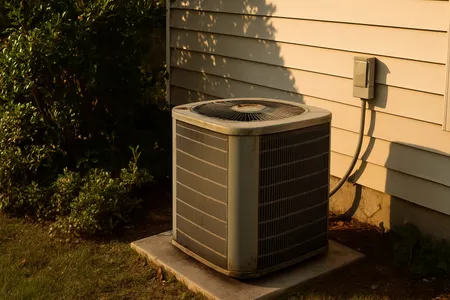
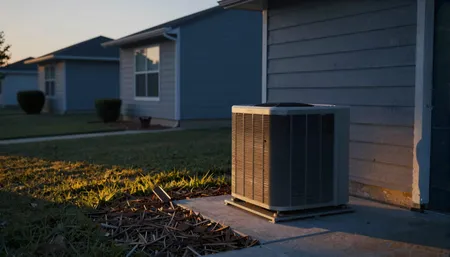
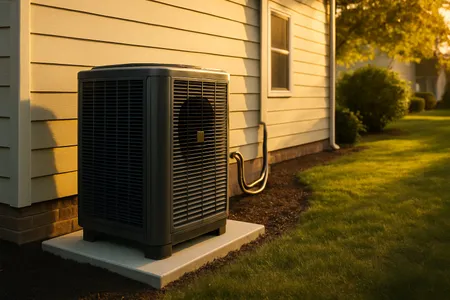
- Outdoor condenser unit — sits outside your home, similar to a traditional AC condenser
- Indoor air handler — mounts on a wall, ceiling, or floor inside the room being cooled
The two components connect through a small conduit (about 3 inches in diameter) that passes through the wall. This conduit carries refrigerant lines, a power cable, and a condensate drain. Because there are no ducts involved, installation is far less invasive than traditional central AC.
Most mini split systems are heat pumps, meaning they can both cool and heat. Single-zone systems have one indoor unit connected to one outdoor unit. Multi-zone systems connect two to five indoor units to a single outdoor condenser, allowing you to cool multiple rooms independently.
What Is Central AC?
Central air conditioning is the traditional whole-home cooling system found in most American homes. It also has two main components:
- Outdoor condenser unit — releases heat from the refrigerant to the outside air
- Indoor air handler or furnace with evaporator coil — cools the air before distributing it
The cooled air travels through a network of ducts hidden in walls, floors, and ceilings, exiting through supply vents in each room. Return vents pull warm air back to the air handler to be cooled again.
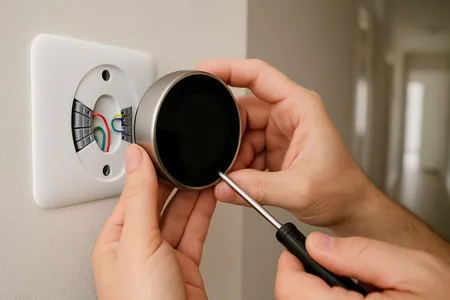
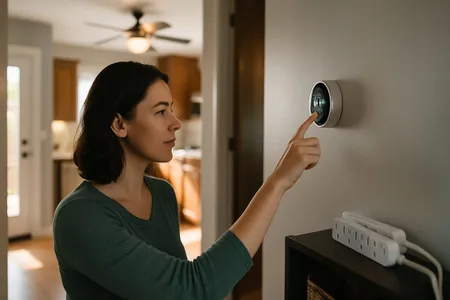
Central AC is controlled by a single thermostat, typically mounted in a hallway or living area, which sets one temperature for the entire home.
Head-to-Head Comparison
Installation Cost
Cost is usually the first question homeowners ask, and the answer depends heavily on whether you already have ductwork.
Central AC:
- Replacement (existing ductwork): $3,500 - $8,000 installed
- New system with ductwork: $7,000 - $15,000 installed
- Adding ductwork alone can cost $3,000 - $7,000 depending on home size and layout
Mini Split:
- Single-zone system: $2,000 - $5,000 installed
- Multi-zone (2-5 rooms): $4,000 - $14,000 installed
- Each additional indoor unit adds roughly $1,500 - $3,000 to the project
The takeaway: If your home already has ductwork in good condition, central AC replacement is typically the most affordable option. If your home lacks ducts — such as an older home, converted garage, or room addition — a mini split avoids the massive expense of installing ductwork from scratch.
Energy Efficiency
This is where mini splits have a clear advantage.
Mini splits commonly carry SEER2 ratings of 16 to 38, with many popular models rated between 20 and 28. Because they deliver cooled air directly into the room, there is zero energy lost in ductwork.
Central AC systems typically range from 14 to 24 SEER2. Even with a high-efficiency unit, the ductwork itself is a weak link. According to the Department of Energy, duct losses account for 20 to 30 percent of the energy used by a central system, especially if ducts run through unconditioned spaces like attics or crawl spaces.
In Central Texas, where attic temperatures regularly exceed 140 degrees F in summer, duct losses can be even higher than the national average. A 20 SEER2 central AC system with leaky attic ducts may perform like a 14 SEER2 system in practice.
The takeaway: A mini split with a 20 SEER2 rating will almost always outperform a central AC with the same rating because it avoids duct losses entirely. If energy efficiency is your top priority, mini splits win.
Operating Costs
The efficiency advantage translates directly to your electric bill.
For a typical 1,500 square foot Central Texas home running cooling about 8 months per year:
| System | Estimated Annual Cooling Cost |
|---|---|
| Central AC (14 SEER2, older ducts) | $1,400 - $1,800 |
| Central AC (18 SEER2, sealed ducts) | $900 - $1,200 |
| Mini split (20 SEER2, whole home) | $700 - $1,000 |
| Mini split (28 SEER2, whole home) | $500 - $750 |
These are estimates based on average electricity rates and Central Texas cooling loads. Your actual costs depend on home insulation, thermostat settings, electricity rate, and usage patterns.
Mini splits offer an additional cost advantage: you only cool the rooms you are using. If you spend most of your time in the living room and bedroom, you can turn off the other zones entirely. Central AC cools the entire home whether you are using every room or not.
The takeaway: Expect mini splits to reduce cooling costs by 20 to 30 percent compared to a central AC system of similar capacity, and potentially more if you take advantage of zone control.
Comfort and Temperature Control
Mini splits give you independent temperature control in each room. This is their standout comfort feature. If someone in the bedroom wants 68 degrees F while the living room is set to 74 degrees F, a mini split system handles that effortlessly. Hot and cold spots between rooms are largely eliminated because each zone has its own thermostat and air handler.
The downside is that mini split air handlers blow air from a fixed location on the wall, which can create a draft directly below the unit. High-quality models with multi-directional vanes handle this well, but cheaper units may create noticeable airflow patterns.
Central AC provides more even air distribution throughout each room because supply vents are spread across the ceiling or floor. However, you get only one thermostat for the entire home. Rooms farther from the air handler or on upper floors tend to be warmer, and balancing airflow across all rooms can be difficult.
The takeaway: Mini splits win on precision and zone control. Central AC wins on even air distribution within individual rooms. For homes where family members have different temperature preferences, mini splits are the better choice.
Installation Complexity
Mini split installation is straightforward. The installer mounts the indoor unit on the wall, places the outdoor condenser on a pad or bracket outside, drills a 3-inch hole through the wall for the line set, and connects the refrigerant lines. A single-zone install can be completed in as little as 4 to 6 hours. Multi-zone systems take 1 to 2 days.
No ductwork, no major structural work, and minimal disruption to your home.
Central AC installation is more involved. Replacement of an existing system (condenser and air handler swap) typically takes 1 day. But if you need new ductwork, the project expands to 2 to 5 days and may involve cutting into walls, ceilings, and floors. Duct installation in finished homes is one of the most expensive and disruptive HVAC projects.
The takeaway: Mini splits are dramatically easier and faster to install, especially in homes that lack existing ductwork.
Aesthetics
This is one area where central AC has a clear edge.
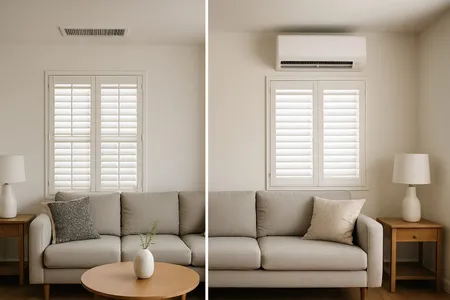
Central AC is essentially invisible inside the home. You see supply vents and return grilles, which sit flush with walls or ceilings. The thermostat is the only visible control. Everything else is hidden.
Mini splits have a wall-mounted indoor unit in each conditioned room. These units are typically 30 to 40 inches wide and 10 to 14 inches tall, and they hang near the ceiling. Modern models are sleeker than older designs, but they are still visible. Some homeowners find them unattractive, while others get used to them quickly.
Ceiling cassette and ducted mini split options exist for homeowners who want the efficiency of a mini split with a less visible indoor component, though these cost more and require some ceiling space.
The takeaway: If a clean, hidden system matters to you, central AC wins on aesthetics. If you do not mind the indoor unit appearance (or choose a ceiling cassette), it is a non-issue.
Noise Levels
Mini split indoor units are remarkably quiet. Most operate between 19 and 40 decibels on low fan speed — roughly equivalent to a whisper or a quiet library. This makes them excellent for bedrooms, home offices, and nurseries.
Central AC is quiet at the outdoor unit (comparable to a mini split outdoor unit at 50 to 60 dB), but the blower and airflow through ducts creates more indoor noise, typically 40 to 55 decibels at the vent. Duct noise can be worse if ducts are undersized, poorly sealed, or have sharp bends.
The takeaway: Mini splits are meaningfully quieter indoors. If noise is a concern, especially in sleeping areas, mini splits have the advantage.
Maintenance
Both systems require regular maintenance to perform well and last their full lifespan.
Central AC maintenance:
- Replace or clean air filter every 1 to 3 months
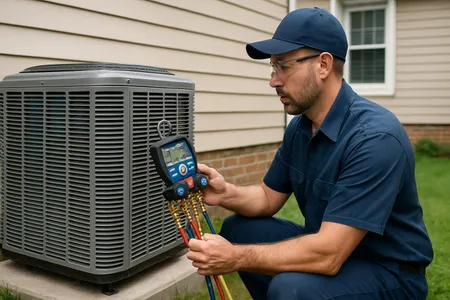
- Annual professional tune-up (coil cleaning, refrigerant check, electrical inspection)
- Duct cleaning every 3 to 5 years (optional but recommended)
- Keep outdoor unit clear of debris
Mini split maintenance:
- Clean indoor unit filters every 2 to 4 weeks (they collect dust faster due to direct room exposure)
- Clean indoor unit coils and blower wheel every 3 to 6 months
- Annual professional tune-up
- Keep outdoor unit clear of debris
Mini splits require more frequent owner maintenance because the indoor air handler is exposed directly to room air and dust. If you skip filter and coil cleaning, performance drops noticeably and the unit can develop mold or odor issues. Self-cleaning models with antimicrobial coatings help, but regular cleaning is still necessary.
The takeaway: Central AC is lower maintenance for the homeowner. Mini splits need more frequent attention but the tasks are simple and take just a few minutes.
Lifespan
Both systems last 15 to 20 years with proper maintenance. The key factors that affect lifespan are the same for both:
- Quality of installation
- Regularity of maintenance
- Local climate demands (Central Texas systems work harder than those in mild climates)
- Quality of the equipment itself
In practice, many well-maintained central AC and mini split systems in Central Texas last 15 to 18 years before efficiency drops enough to justify replacement. Systems that are neglected or improperly sized may fail in 10 to 12 years.
When to Choose a Mini Split
A mini split is likely the better choice if:
- Your home does not have ductwork — common in older homes, converted spaces, and additions
- You are adding a room or finishing a garage — extending ductwork is expensive and often impractical
- You want zone control — cool only the rooms you use, set different temperatures per room
- You have hot or cold spots — supplement your central system in problem areas
- Your home has high ceilings or open layouts — mini splits can target occupied zones efficiently
- You want heating and cooling in one system — most mini splits are heat pumps
- Energy efficiency is a top priority — no duct losses means maximum efficiency
- You are cooling a detached workshop, studio, or ADU — mini splits are the simplest solution for outbuildings
When to Choose Central AC
Central AC is likely the better choice if:
- Your home already has ductwork in good condition — replacement is fast and affordable
- You are building a new home — ductwork is easy to install during construction
- You want a hidden system — no visible indoor units on walls
- You are cooling a large home (3,000+ sq ft) — central systems scale more cost-effectively for big spaces
- You prefer minimal maintenance involvement — filter changes every few months vs. frequent mini split cleaning
- Your family agrees on one temperature — a single thermostat works fine
- Budget is tight and you have existing ducts — central AC replacement is the most affordable whole-home option
Can You Use Both?
Yes, and this hybrid approach is more common than most homeowners realize.
The most popular hybrid setup is keeping your central AC for the main living areas while adding a single-zone mini split for a problem area. Common examples:
- A room addition or converted garage that the existing ductwork cannot reach
- An upstairs bonus room that is always too hot because heat rises and ductwork to upper floors is often undersized
- A home office where you want precise temperature control and quiet operation without cooling the entire house
- A sunroom or enclosed porch that is not connected to the duct system
This approach gives you the whole-home comfort of central AC where ducts already exist, plus the efficiency and zone control of a mini split exactly where you need it. A single-zone mini split addition typically costs $2,000 to $5,000, which is far less than modifying your entire duct system.
Central Texas Climate Considerations
Living in the Killeen, Temple, and Waco area means your cooling system works harder than in most parts of the country. Here is what that means for this decision:
Extreme heat load: Central Texas regularly sees 100 degrees F or higher from June through September, with some summers pushing 105 to 110 degrees F. The region averages over 2,500 cooling degree days per year. Your AC system runs for 8 or more months annually, which means efficiency differences between mini splits and central AC compound into significant cost differences over time.
Attic temperatures matter: If your ductwork runs through the attic (as it does in most Central Texas homes), those ducts are sitting in 130 to 150 degree F air during peak summer. Even well-insulated ducts lose substantial energy in these conditions. This is the single biggest reason mini splits outperform their rated efficiency advantage over central AC in this region.
Humidity: Central Texas humidity is moderate compared to the Gulf Coast, but still high enough that proper dehumidification matters for comfort. Both central AC and mini splits dehumidify as they cool. Mini splits with inverter compressors can run at low speed for extended periods, which actually improves dehumidification compared to standard central AC systems that cycle on and off.
Electricity costs: Texas electricity rates vary widely depending on your provider and plan, but the average residential rate in 2026 is around $0.12 to $0.15 per kWh. At these rates, the 20 to 30 percent efficiency advantage of mini splits can save $200 to $500 per year in a typical home.
Frequently Asked Questions
Is a mini split cheaper to run than central AC?
Yes, in most cases. Mini splits are 20 to 30 percent more efficient than central AC due to the elimination of duct losses. The savings are even greater in homes where ducts run through unconditioned spaces like attics. Over a 15-year lifespan, this can add up to $3,000 to $7,500 in energy savings.
Can a mini split cool a whole house?
Yes. A multi-zone mini split system with 3 to 5 indoor units can cool an entire home. However, the upfront cost for whole-home mini split coverage ($4,000 to $14,000+) can approach or exceed central AC pricing, especially if your home already has ductwork. Mini splits are most cost-effective when used for targeted zones rather than whole-home replacement of a ducted system.
How long does a mini split last compared to central AC?
Both systems last 15 to 20 years with proper maintenance. Neither has a significant lifespan advantage over the other. The quality of installation and consistency of maintenance are more important than the system type.
Do mini splits work in extreme heat?
Yes. Modern inverter-driven mini splits perform well even in temperatures above 110 degrees F. Look for models with a rated cooling capacity at high ambient temperatures. Brands like Mitsubishi, Fujitsu, Daikin, and LG all offer models rated for extreme heat conditions common in Central Texas.
Are mini splits noisy?
Mini split indoor units are among the quietest HVAC equipment available, operating at 19 to 40 decibels on low speed. That is quieter than a normal conversation (60 dB) and comparable to a whisper. The outdoor unit produces 50 to 60 decibels, similar to a central AC condenser.
Do mini splits decrease home value?
Not typically. A well-installed mini split system can increase home value, especially in areas without existing ductwork. However, poorly installed units with visible line sets or improperly placed indoor units can look unappealing. Professional installation with clean line set covers and thoughtful unit placement avoids this issue.
Ready to Decide? We Can Help
Whether you are leaning toward a mini split, central AC, or a hybrid approach, the best system for your home depends on your specific layout, ductwork condition, budget, and comfort priorities.
Call Texas Temp Masters at (817) 704-0706 to schedule a free in-home consultation. We serve Killeen, Temple, Waco, Copperas Cove, Belton, Harker Heights, and the surrounding Central Texas area.
Not sure what size system you need? Try our BTU Calculator to estimate your cooling load, or use our Cost Estimator to get a ballpark price for your project.
Next Steps
If you found this comparison helpful, these related guides may help you make your final decision:
- HVAC System Cost Guide — Full breakdown of what a new HVAC system costs in 2026
- SEER vs SEER2 Explained — Understand the new efficiency ratings and what they mean for you
- Energy Savings Calculator — See how much a higher-efficiency system could save you
- Repair or Replace Calculator — Find out if your current system is worth fixing or if replacement makes more sense