
Need to know how old your HVAC system is? Enter the brand and serial number below and we'll decode the manufacture date, show you where it sits in its expected lifespan, and help you plan ahead.
How It Works
Every HVAC manufacturer encodes the manufacture date somewhere in the serial number. Some brands use the first four digits as a week-and-year code, others embed the year in specific character positions, and a few use letter-based month codes. Our decoder knows the format for each brand and extracts the exact manufacture year automatically.
Once we know when your system was built, we compare its age against the industry-average lifespan for that equipment type -- central air conditioners average 15 years, gas furnaces 20 years, heat pumps 14 years, and mini-splits around 15 years. The result is a visual lifespan gauge showing how much useful life remains and guidance on whether it is time to start budgeting for a replacement.
Supported Brands (22+)
Helps improve decoding accuracy. Found on the same data plate as the serial number.
Typically on a metal plate on the side or back of the unit.
Example HVAC Age Decoder Results
Carrier Central AC
- Serial Number
- 1214E33456
- Manufacture Year
- 2014
- System Age
- 12 years
- Expected Lifespan
- 15 years
- Lifespan Used
- 80%
This Carrier AC is nearing the end of its expected 15-year lifespan. Consider budgeting for replacement within 2-3 years.
Trane Heat Pump
- Serial Number
- 2034E12345
- Manufacture Year
- 2020
- System Age
- 6 years
- Expected Lifespan
- 14 years
- Lifespan Used
- 43%
This Trane heat pump has plenty of life left. Regular maintenance will help it reach or exceed its expected lifespan.
Goodman Furnace
- Serial Number
- 1808123456
- Manufacture Year
- 2018
- System Age
- 8 years
- Expected Lifespan
- 20 years
- Lifespan Used
- 40%
This Goodman furnace is less than halfway through its expected life. Keep up with annual maintenance for maximum longevity.
How to Find Your HVAC Serial Number
Real HVAC Nameplate Examples
Here are real data plate photos from HVAC units we service. The serial number is typically printed alongside the model number on these plates.
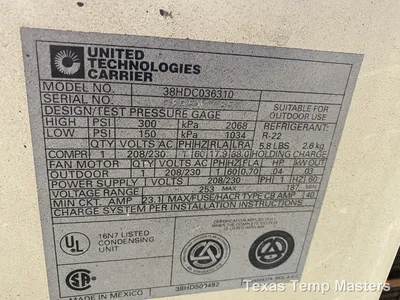
Carrier Condenser Nameplate

Trane XR13 Nameplate

Lennox Condenser Nameplate

Rheem Condenser Nameplate
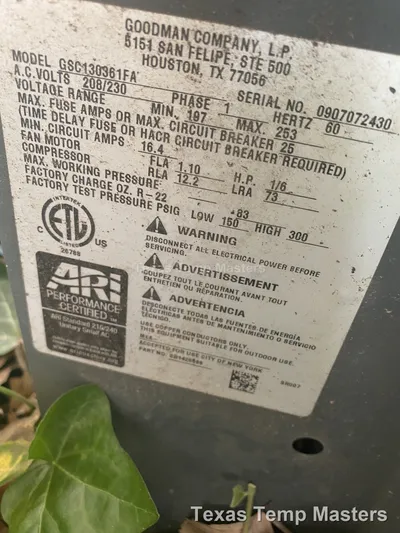
Goodman Condenser Nameplate

Bryant Heat Pump Nameplate
Every HVAC system has a data plate (sometimes called a nameplate or rating plate) with the model and serial number. Here's where to look:
- Central AC (outdoor unit): On the metal data plate on the side of the condenser unit, usually near the service valve connections or the electrical panel cover
- Furnace: On the data plate inside the furnace cabinet — open the front panel or blower door to find it
- Heat Pump (outdoor unit): On the data plate on the side of the unit, similar location to a central AC condenser
- Mini-Split: On the outdoor unit's side panel or on the indoor unit's data plate (behind the front cover or on the side)
- Package Unit: On the data plate on the exterior panel of the unit, typically near the electrical disconnect
- Boiler: On the front panel, side panel, or behind the burner access door
Brands We Decode
Our HVAC age decoder supports all major brands and their subsidiaries:
- Carrier family: Carrier, Bryant, Payne, Heil, Day & Night, Arcoaire
- Trane family: Trane, American Standard
- Lennox: Lennox, including Allied, Armstrong, Ducane, and Concord
- Rheem family: Rheem, Ruud, Richmond, Weather King
- Goodman family: Goodman, Amana HVAC (owned by Daikin)
- York family: York, Coleman, Luxaire, Fraser-Johnston
- Daikin: Daikin branded equipment
- Ductless systems: Mitsubishi Electric, Fujitsu
Average HVAC Lifespans
Understanding your system's expected lifespan helps you budget for replacements and make smarter repair decisions:
- Central Air Conditioner: 15-20 years
- Gas Furnace: 15-20 years
- Heat Pump: 10-15 years
- Mini-Split: 12-20 years (average 15 years)
- Package Unit: 12-18 years (average 15 years)
- Boiler: 15-30 years (average 20 years)
When your system approaches the end of its expected life, our Repair or Replace Calculator can help you decide whether a repair is worth the investment, and our HVAC Cost Estimator can give you Good/Better/Best pricing for a new system.
Frequently Asked Questions
Can you tell the age of an HVAC unit by the serial number?
Can you tell the manufacture date from a serial number?
How do I find out the age of my furnace?
How to read HVAC serial numbers?
How to check AC manufacturing date?
Is a 20-year-old furnace too old?
How do I read my Goodman serial number?
Where can I find my HVAC serial number?
Get a Free Quote — (817) 704-0706
Fill this out and we'll call you back within 15 minutes during business hours (Mon–Fri 8–5).
Related Resources
Related Tools
- Repair or Replace Calculator — Should you fix it or replace it?
- HVAC Cost Estimator — Get replacement pricing estimates
- Energy Savings Calculator — Project savings from a SEER upgrade
Need Emergency HVAC Service?
Don't wait when your heating or cooling system fails. Our licensed technicians provide emergency service throughout Central Texas with guaranteed satisfaction.