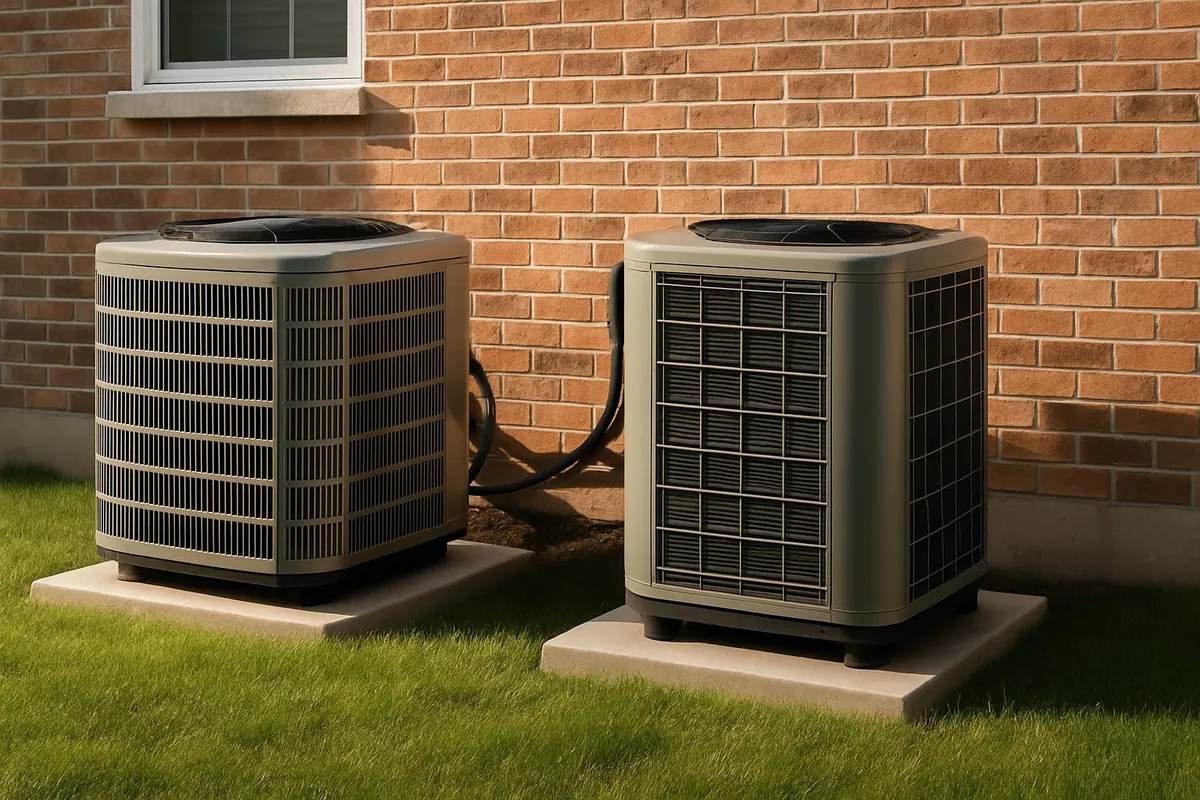
Heat pumps and air conditioners look nearly identical from the outside and cool your home in the exact same way. So what is the difference, and does it matter which one you choose? This guide explains everything in plain language.
Quick Comparison: Heat Pump vs Air Conditioner
| Feature | Heat Pump | Air Conditioner |
|---|---|---|
| Cooling | Yes | Yes |
| Heating | Yes | No |
| How cooling works | Identical to AC | Standard refrigerant cycle |
| Upfront cost | Higher | Lower |
| Annual cooling cost | Same as AC | Same as heat pump |
| Annual heating cost | Lower than gas/electric furnace heat, typically | Requires separate furnace |
| Efficiency (cooling) | Same as equivalent AC | Same as equivalent heat pump |
| Lifespan | 12 - 15 years | 15 - 20 years |
| Maintenance | 2 tune-ups/year | 1 tune-up/year |
| Best for | Heating + cooling in one | Homes that already have a furnace |
How Each System Works
Air Conditioner
An air conditioner uses a refrigerant cycle to absorb heat from your indoor air and release it outside. The system includes an indoor evaporator coil (which absorbs heat), a compressor (which pressurizes refrigerant), and an outdoor condenser coil (which releases heat). The refrigerant flows in one direction only.
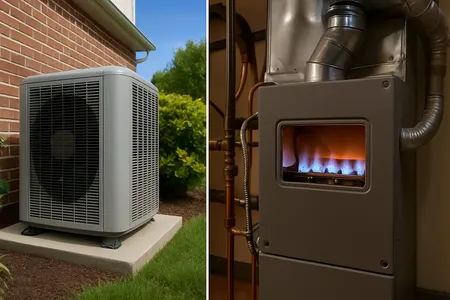
An air conditioner only cools. For heating, you need a separate system like a gas furnace, electric furnace, or boiler.
Heat Pump
A heat pump works exactly like an air conditioner in cooling mode. The components are virtually identical. The crucial difference is a component called a reversing valve that allows the refrigerant to flow in both directions.
In cooling mode, a heat pump operates identically to an AC. In heating mode, the reversing valve flips the cycle: the outdoor coil absorbs heat from the outside air, and the indoor coil releases it into your home. This allows one system to provide both heating and cooling.
The Bottom Line
When cooling your home, there is no functional difference between a heat pump and an air conditioner. They operate the same way, use the same amount of energy, and deliver the same comfort. The only difference is the heat pump’s ability to reverse the cycle for heating.
Pros and Cons
Heat Pump Pros
- One system for heating and cooling: Eliminates the need for a separate furnace
- Higher heating efficiency: 200% to 400% efficient in heating mode, far more efficient than electric resistance heat
- Lower total system cost: A heat pump alone costs less than a furnace-plus-AC combo
- Tax credits: The federal Section 25C credit (IRS) of up to $2,000 for qualifying models expired December 31, 2025 (see our 2026 tax credits guide for what’s still available)
- No combustion: No carbon monoxide risk, no gas line required
- Smaller carbon footprint: Lower emissions, especially with renewable electricity
Heat Pump Cons
- Shorter lifespan: 12 to 15 years vs. 15 to 20 years for an AC (because it runs year-round)
- Reduced heating efficiency in extreme cold: Standard models lose efficiency below 25-30 degrees Fahrenheit
- Higher maintenance frequency: Two tune-ups per year vs. one for a cooling-only AC
- Supplemental heat may be needed: In cold climates, backup heat strips or a gas furnace may be necessary
- Less intense heat: Delivers warm air (90-100 degrees Fahrenheit) vs. furnace heat (120-140 degrees Fahrenheit)
Air Conditioner Pros
- Lower upfront cost: Costs less upfront than a heat pump of comparable size — ask for a quote to compare exact models
- Longer lifespan: 15 to 20 years since it only runs during cooling season
- Proven technology: Widely available, well-understood by all HVAC technicians
- Less maintenance: Only one tune-up per year
- Pairs with any heating system: Works with gas furnaces, electric furnaces, or boilers
Air Conditioner Cons
- Cooling only: Requires a separate heating system, adding to total cost
- Higher total system cost: paying for a separate AC and furnace adds up to more than a single heat pump typically costs
- Two systems to maintain: Separate maintenance for AC and furnace
- No heating tax credits: AC-only systems never qualified for the federal heat pump credit, which itself expired December 31, 2025
Cost Comparison
Upfront cost depends heavily on the configuration. An air conditioner alone costs the least upfront; pairing it with a separate gas or electric furnace costs more than the AC alone, and typically more than a heat pump installed by itself. A dual-fuel heat-pump-plus-furnace setup costs the most upfront of these configurations. Which setup costs less to run over a year depends on your climate, your electricity and gas rates, and the efficiency of the specific equipment — a heat pump’s cooling costs run about the same as an equivalent AC, and its heating costs are typically lower than furnace heat, but the exact numbers vary by home. Ask for a written, itemized quote to compare exact models for your home; these prices may vary case by case.
For a detailed price breakdown, see our AC Replacement Cost and Heat Pump Cost guides.
Which Is Better for Different Scenarios
Scenario 1: Replacing an Old AC (Furnace Still Works)
Best choice: Air conditioner
If your furnace is in good condition and relatively new (under 10 years), there is no reason to replace the entire system. A new air conditioner will match the efficiency of a heat pump in cooling mode and costs significantly less.
Scenario 2: Replacing Both AC and Furnace
Best choice: Heat pump
When both systems need replacement, a heat pump often makes more financial sense. One system replaces two, reducing total upfront cost — the federal tax credit that used to further close the gap expired December 31, 2025.
Scenario 3: Mild Climate (Southeast, Southwest, Pacific Coast)
Best choice: Heat pump
In regions with mild winters, heat pumps operate at peak efficiency year-round. The heating cost savings are substantial compared to any alternative, and the system rarely encounters temperatures where performance drops.
Scenario 4: Cold Climate (Northeast, Upper Midwest, Mountain States)
Best choice depends on energy prices
If natural gas is cheap in your area, an AC-plus-gas-furnace combo may cost less to operate. If electricity is affordable, a cold-climate heat pump or dual-fuel system is worth considering.
Scenario 5: No Natural Gas Available
Best choice: Heat pump
Without natural gas, your heating alternatives are electric furnace, propane furnace, or heat pump. The heat pump is dramatically more efficient than electric resistance heating and cheaper to operate than propane.
Scenario 6: New Construction
Best choice: Heat pump
For new construction, a heat pump simplifies the HVAC design (one system vs. two), reduces installation costs (no gas line needed), and provides the most efficient operation from day one.
Expert Recommendation
Here is a simple decision framework:
- If you only need cooling and have a working furnace: Get an air conditioner.
- If you need both heating and cooling: Get a heat pump. It is a single, efficient system for both jobs.
- If you are in a very cold climate: Consider a dual-fuel heat pump with gas furnace backup, or a standard AC + gas furnace if gas is cheap in your area.
- If you have no gas line: A heat pump is almost always the best choice.
The trend in the HVAC industry is clearly moving toward heat pumps. Manufacturer investment, government incentives, and improving cold-climate technology all point to heat pumps as the future of residential heating and cooling.
Frequently Asked Questions
Is a heat pump just an air conditioner that can heat?
Essentially, yes. A heat pump is an air conditioner with a reversing valve that allows it to run in both directions. In cooling mode, it is functionally identical to a traditional air conditioner.
Does a heat pump cool as well as an AC?
Yes. There is no difference in cooling performance between a heat pump and an air conditioner with the same efficiency rating. A 16 SEER2 heat pump cools exactly as well as a 16 SEER2 air conditioner.
Why do heat pumps cost more than air conditioners?
Heat pumps include a reversing valve, a defrost cycle, and are built to handle the additional stress of year-round operation. These components and engineering make a heat pump cost more than an equivalent AC unit — ask for a written quote to compare exact models for your home.
Can I replace my AC with a heat pump?
Yes, and it is a very common upgrade. The heat pump connects to the same ductwork and electrical connections. The main consideration is whether your existing furnace will serve as backup heat or if you will rely entirely on the heat pump.
Which is quieter, a heat pump or an AC?
Both operate at similar noise levels during cooling mode. However, heat pumps may be slightly louder during the heating cycle’s defrost mode, which runs periodically to remove ice from the outdoor coil in cold weather.
In Central Texas? The climate here makes heat pumps an ideal choice for efficient, year-round comfort. Texas Temp Masters can help you decide between a heat pump and an air conditioner based on your home and existing equipment. Call (817) 704-0706 for a free consultation, or visit our Heat Pumps and Air Conditioning pages.
Next Steps
Now that you understand the differences, here is how to move forward:
- Get a price estimate — Use our Cost Estimator to compare heat pump and AC pricing for your home size and efficiency preferences.
- Project your energy savings — Our Energy Savings Calculator shows how much you could save by switching from an AC-plus-furnace setup to a heat pump.
- Dive deeper into heat pump pricing — Read our Heat Pump Cost guide for a full breakdown of installation, operating, and maintenance costs.
- Compare heating options — If heating performance matters most, our Heat Pump vs Furnace guide compares efficiency, comfort, and cost by climate.
- Understand compressor types — Learn how single-stage, two-stage, and variable-speed compressors affect comfort and efficiency in either system.
- Ready to talk? — Contact us for a free evaluation.