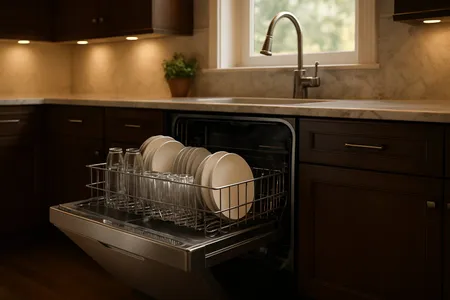
You open your dishwasher expecting clean dishes and instead find a pool of standing water at the bottom. A dishwasher that will not drain is one of the most common appliance problems homeowners face, and it can quickly lead to foul odors, mold growth, and unsanitary conditions if left unaddressed. The good news is that most drainage issues are caused by simple blockages that you can fix yourself in 30 minutes or less with basic household tools. This step-by-step guide covers every common cause of a dishwasher not draining, from the easiest fixes to problems that require a professional. We will walk you through the diagnosis and repair process so you can get your dishwasher back in working order without an expensive service call.
Quick Fix Checklist
Try these steps first. They resolve the majority of dishwasher drainage issues:
- Run the garbage disposal — If your dishwasher drains through the disposal, a clogged disposal will prevent drainage. Run it for 30 seconds with water flowing.
- Check the drain filter — Open the dishwasher, remove the bottom rack, and locate the filter at the bottom of the tub. Remove any visible food debris and rinse the filter under running water.
- Run a drain cycle — Press and hold the “Cancel” or “Drain” button for 3 seconds. Many dishwashers have a dedicated drain mode that can clear minor blockages.
- Inspect the air gap — If you have a chrome cap on the countertop near the sink, remove it and check for debris inside. Clear any visible blockage.
1. Clogged Drain Filter or Trap
What It Is and Why It Happens
Every modern dishwasher has a filter or drain trap at the bottom of the wash tub designed to catch food particles and prevent them from entering the drain pump and hose. Over time, food scraps, grease, broken glass, label residue from jars, and other debris accumulate in the filter. When the filter becomes clogged, water cannot pass through to the drain pump and instead pools at the bottom of the dishwasher. This is the most common cause of drainage problems.
How to Check
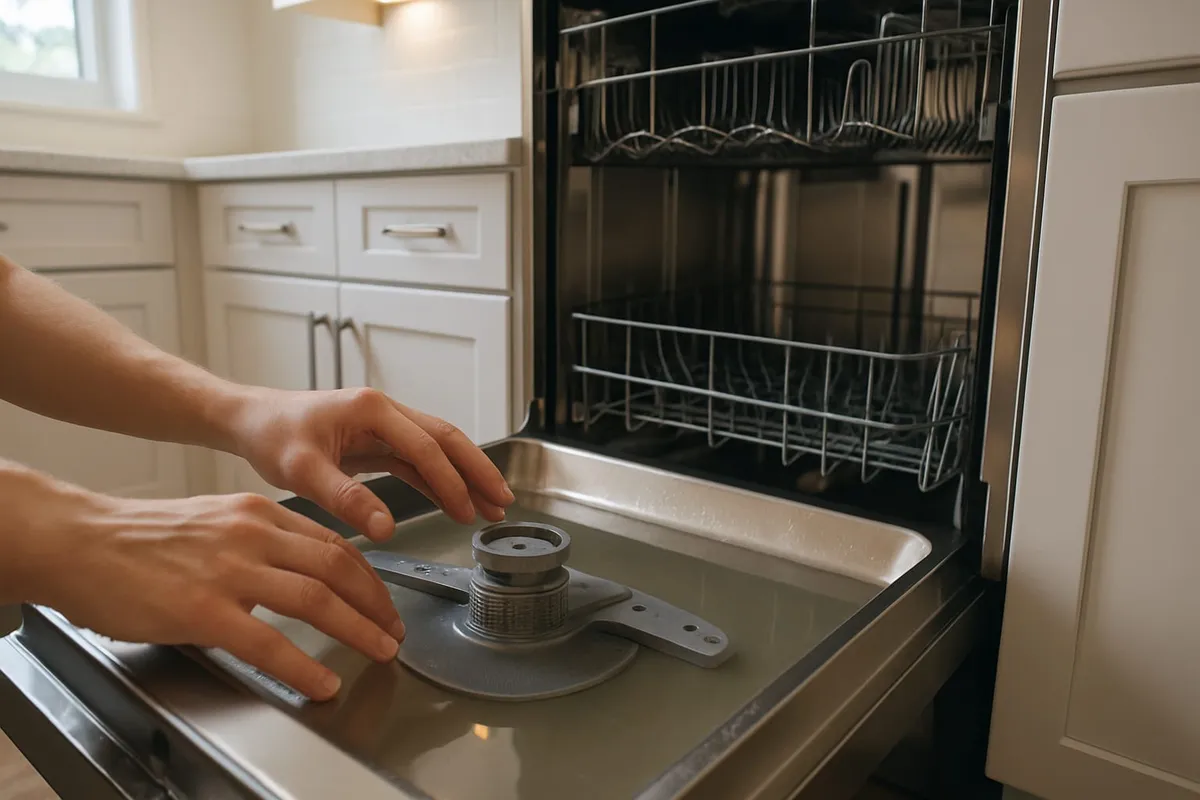
Open the dishwasher and remove the bottom dish rack. Look at the floor of the dishwasher, near the center or the back, for a cylindrical or flat filter assembly. Most modern dishwashers have a two-part filter: a main filter (cylinder) and a flat fine mesh filter underneath. Twist the cylindrical filter counterclockwise to remove it, then lift out the fine mesh screen.
How to Fix
- Remove both filter components.
- Rinse them under warm running water, using a soft brush (an old toothbrush works well) to scrub away food particles and grease.
- Inspect the sump area (the cavity under the filter) for any debris. Remove anything you find with a paper towel or by hand.
- Reassemble the filter by placing the flat screen back first, then inserting and twisting the cylindrical filter clockwise to lock it.
- Run a short wash cycle to test drainage.
Clean the filter at least once a month to prevent buildup. If you frequently have drainage problems, clean it weekly.
Estimated cost: Free (DIY fix).
2. Garbage Disposal Blockage
What It Is and Why It Happens
In most kitchen configurations, the dishwasher drain hose connects to the garbage disposal or the drain pipe next to it. If the disposal is full of food waste or has not been run before starting the dishwasher, water from the dishwasher has nowhere to go and backs up into the tub. If your disposal was recently installed, another common issue is that the knockout plug inside the disposal inlet was never removed, completely blocking the dishwasher drain connection.
How to Check
Turn on the sink faucet and run the garbage disposal. If the disposal grinds slowly, does not drain properly, or makes a humming sound without grinding, it is either clogged or jammed. Also check: if you recently had a new garbage disposal installed and the dishwasher has not drained since, the knockout plug may still be in place.
How to Fix
For a clogged disposal: Run the disposal with cold water flowing for 30 to 60 seconds to clear any accumulated food waste. If the disposal is jammed (you hear humming but the blades are not spinning), turn off the power, insert the hex wrench (usually included with the disposal) into the bottom of the unit, and manually rotate the grinding plate back and forth to free the jam.
For a forgotten knockout plug: Turn off the disposal and use a hammer and a wooden dowel or screwdriver handle to knock the plug inward from the disposal inlet where the dishwasher hose connects. Remove the plug from inside the disposal.
Estimated cost: Free (DIY fix).
3. Clogged or Kinked Drain Hose
What It Is and Why It Happens
The drain hose is the ribbed rubber or plastic tube that carries water from the dishwasher pump to either the garbage disposal, the air gap, or the sink drain. Over time, grease, food particles, and soap scum can build up inside the hose and create a partial or complete blockage. The hose can also become kinked if the dishwasher was pushed too far back against the wall or if the hose was not properly routed during installation.
How to Check
Pull the dishwasher out from under the counter (first disconnect the power and water supply). Inspect the full length of the drain hose for kinks, bends, or visible damage. The hose runs from the drain pump at the bottom of the dishwasher to the connection point under the sink.
How to Fix
For kinks: Straighten the hose and ensure it has a smooth path from the dishwasher to the drain connection. Avoid sharp bends. The hose should loop up to the underside of the countertop before going down to the drain connection (this is called a “high loop” and prevents backflow).
For clogs: Disconnect the hose at both ends (place a bucket underneath to catch water). Use a long bottle brush or a straightened wire hanger (be careful not to puncture the hose) to clear the blockage. Flush the hose with warm water. Reconnect and test.
For old or deteriorated hoses: If the hose is cracked, brittle, or impossible to clean, replace it. Dishwasher drain hoses are inexpensive and available at most hardware stores.
Estimated cost: Free for straightening a kink. A replacement hose is inexpensive if you do it yourself; ask for a quote if you’d rather have a professional handle it.
4. Air Gap Blockage
What It Is and Why It Happens
An air gap is a small, dome-shaped device (usually with a decorative chrome or stainless steel cap) mounted on the countertop or sink near the faucet. Not all homes have one, but where required by local plumbing codes, the air gap prevents contaminated water from the sink or disposal from flowing backward into the dishwasher. The air gap has two internal channels, and food debris can accumulate inside, blocking the dishwasher’s drain path.
How to Check
If you have an air gap, remove the decorative cap (it usually just pulls off) and then remove the inner plastic cap. Look inside the small opening for food debris, grease, or mineral buildup.
How to Fix
Remove any visible debris with tweezers or a small brush. Clean the inside of both the input and output channels by running a small bottle brush through them. You can also blow air through the channels using a turkey baster or compressed air. After cleaning, replace both caps and run a drain cycle to test.
Estimated cost: Free (DIY fix).
5. Drain Pump Failure
What It Is and Why It Happens
The drain pump is an electric motor and impeller assembly that actively pushes water out of the dishwasher and through the drain hose. Over time, the pump motor can burn out, the impeller can break or become jammed by foreign objects (broken glass, bones, fruit pits), or the electrical connections can fail. When the drain pump fails, you will typically hear no sound during the drain portion of the cycle, or you may hear a humming sound indicating the motor is trying to run but is jammed.
How to Check
Start a drain cycle and listen carefully at the bottom of the dishwasher. You should hear the pump motor running — it makes a whirring or buzzing sound. If you hear nothing during the drain phase, the pump motor may have failed. If you hear humming but no water movement, the impeller may be jammed or broken.
How to Fix
First, check for obstructions. With the dishwasher off and unplugged, remove the filter and check the sump area for debris that may have gotten into the pump. Some dishwashers allow access to the pump impeller through the filter area — you may be able to see and remove a foreign object.
If the pump motor itself has failed, call a professional. Replacing a drain pump requires disassembling the bottom of the dishwasher, disconnecting electrical and plumbing connections, and installing the correct replacement part.
Estimated cost: Ask your technician for a quote — a drain pump replacement includes both the part and the labor to access and reinstall it.
6. Drain Valve Problems
What It Is and Why It Happens
Some older dishwashers use a drain valve (also called a drain solenoid) to control when water exits the dishwasher. The valve opens electrically during the drain cycle and closes during wash and rinse cycles. If the valve fails in the closed position, water cannot drain. In newer dishwashers, the drain pump handles this function directly, but if you have an older model (typically 10+ years old), a stuck drain valve may be the culprit.
How to Check
This is difficult to diagnose without disassembling the dishwasher. If you have checked all other potential causes (filter, hose, disposal, air gap) and the drain pump sounds like it is running normally, a stuck drain valve may be the issue. Check your dishwasher manual to determine if your model has a separate drain valve.
How to Fix
Call a professional. Drain valve replacement requires accessing the bottom of the dishwasher and working with electrical connections.
Estimated cost: Ask your technician for a quote for professional drain valve replacement.
7. Incorrect Dishwasher Installation
What It Is and Why It Happens
If your dishwasher was recently installed or moved and has never drained properly, the installation itself may be the problem. Common installation errors include:
- No high loop or air gap on the drain hose, which allows water to siphon back into the dishwasher.
- The drain hose connected to the wrong port on the garbage disposal (the knockout plug was not removed).
- The drain hose running downhill instead of looping upward.
- The drain hose pushed too far into the disposal or drain connection, creating a restriction.
How to Check
Trace the drain hose from the dishwasher to its connection point. Verify that the hose loops upward to at least the height of the countertop before descending to the drain connection. Check that the connection at the disposal or drain pipe is secure and not pushed in too far (the hose should not extend more than half an inch into the connection).
How to Fix
Reroute the drain hose to include a proper high loop, securing it to the underside of the countertop with a hose clamp or zip tie. Ensure the hose end is not inserted too far into the disposal connection. If a knockout plug was not removed from a new disposal, remove it as described in the Garbage Disposal Blockage section above.
Estimated cost: Free to inexpensive for hose clamps (DIY fix).
When to Call a Professional
While many dishwasher drainage problems have simple solutions, contact a professional if:
- The drain pump is not running at all — A failed pump motor requires replacement.
- Water is leaking from under the dishwasher — This may indicate a cracked pump housing, loose connections, or a damaged tub.
- The dishwasher displays an error code you cannot resolve — Consult your manual and search for the specific code before calling, but error codes related to drain pumps and water level sensors often require professional diagnosis.
- You have checked everything in this guide and still have standing water — There may be an issue with the control board not sending the drain signal, or an internal plumbing problem.
- The dishwasher is leaking from the door or sides — This is a separate issue from drainage and may involve the door gasket, spray arms, or overfilling.
For appliance issues, visit our contact page or use our troubleshooter tool for guided help.
Prevention Tips
Keep your dishwasher draining properly with these maintenance habits:
- Scrape dishes before loading — You do not need to pre-rinse (modern detergent actually works better with some food residue), but scrape off large food particles, bones, toothpicks, and labels.
- Clean the filter monthly — Remove the filter assembly, rinse it under warm water, and scrub with a soft brush. This single step prevents most drainage problems.
- Run the garbage disposal before starting the dishwasher — Clear the disposal so the shared drain path is open.
- Run hot water at the sink before starting a cycle — This ensures the dishwasher starts with hot water, which dissolves grease more effectively and prevents buildup in the drain system.
- Run a cleaning cycle monthly — Place a cup of white vinegar in the top rack and run a hot cycle with the dishwasher empty. This breaks down grease and mineral deposits in the drain system.
Frequently Asked Questions
Why is there standing water in the bottom of my dishwasher?
A small amount of water (about a cup) in the bottom of the dishwasher is normal and keeps the pump seals from drying out. However, if there are several inches of standing water, the most common causes are a clogged drain filter, a blocked garbage disposal, a kinked or clogged drain hose, or a failed drain pump. Start by cleaning the filter and running the disposal, then work through the other causes in this guide.
Can I use Drano or drain cleaner in my dishwasher?
No. Never use chemical drain cleaners like Drano in your dishwasher. These products contain harsh chemicals that can damage the dishwasher’s rubber seals, plastic components, and drain pump. They can also leave chemical residue on your dishes. Instead, use a mixture of baking soda and vinegar for natural cleaning, or use a dishwasher-specific cleaner.
How do I force my dishwasher to drain?
Most dishwashers have a cancel or drain function. Press and hold the “Cancel” or “Drain” button for 3 to 5 seconds. The dishwasher should begin a drain cycle. If the control panel is unresponsive, turn off the power at the circuit breaker for 60 seconds, then turn it back on and try the drain cycle again. As a last resort, you can manually remove water with a cup, sponge, or wet/dry vacuum.
Why does my dishwasher not drain completely?
If a small amount of water remains after each cycle (half an inch or less), this is normal by design. If significantly more water remains, the most likely causes are a partially clogged filter, a partial blockage in the drain hose, or a failing drain pump that does not generate enough force to push all the water out. Clean the filter first, then check the drain hose for restrictions.
How much does it cost to fix a dishwasher that won’t drain?
Many drainage fixes are free or very inexpensive (cleaning the filter, clearing the disposal, straightening a kinked hose). A drain pump replacement or a new drain hose cost more, and a technician can quote the exact number once they’ve diagnosed the cause. If the repair estimate approaches 50 percent of the cost of a new dishwasher, consider replacement instead.
A dishwasher that will not drain is usually a simple fix once you identify the cause. Work through this guide from top to bottom, starting with the easiest checks first. Most homeowners can resolve the problem themselves in under an hour.
If you are in Central Texas and need appliance repair help, Texas Temp Masters offers fast service. Call (817) 704-0706 or contact us online to schedule your appointment.
Next Steps
If your dishwasher drainage issue is resolved, take these steps to stay ahead of future problems:
- Should you repair or replace? — Use our Repair or Replace Calculator to get a data-driven recommendation based on your dishwasher’s age and repair cost.
- Find out how old your dishwasher is — Our Appliance Age Decoder reads the manufacture date from your serial number so you know where your unit stands.
- Learn your dishwasher’s expected lifespan — Read how long does a dishwasher last for brand-by-brand lifespan data and warning signs of failure.
- Compare across all your appliances — Our appliance lifespan chart covers 20+ appliances to help you plan replacements and budget ahead.
- Ready to talk? — Contact us for a free evaluation.