When there’s no hot water, the cause splits cleanly by heater type: on an electric water heater it’s most often a tripped breaker or a tripped high-limit reset button; on a gas heater it’s a pilot light or gas-supply problem; on a tankless unit it’s usually a displayed error code, a flow issue, or gas supply. Lukewarm-but-not-hot water points elsewhere — a failed element, a stuck dip tube, sediment, or an undersized tank losing the morning-shower race. Work through the section for your heater type below; several of these fixes take five minutes and cost nothing.
Safety first, honestly stated: if you smell gas near the heater, stop — leave the house and call your gas utility from outside. Water heaters also combine 240V electricity or open flame with stored scalding water; if any step below feels beyond you, that’s what the phone is for.
First, Which Type Do You Have?
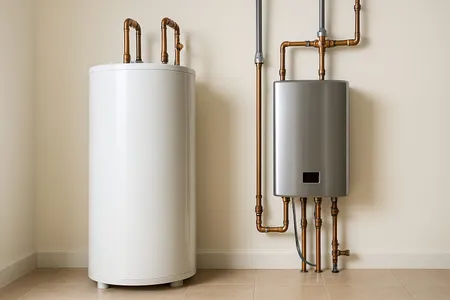
- Gas tank: a flue pipe on top, a gas line and a control valve near the bottom, often a small viewing window for the pilot.
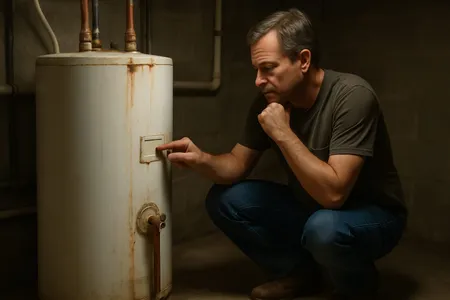
- Electric tank: no flue, an electrical conduit or cable entering the top or side, one or two access panels on the tank’s side.
- Tankless: a wall-hung box (usually gas) with a digital display.
Electric Water Heater: No Hot Water
- Check the breaker. Electric water heaters run on a dedicated double-pole 240V breaker. A half-tripped double breaker can look “on” — flip it fully off, then firmly on. If it re-trips, stop and call; a breaker that won’t hold means a short (often a failed element grounding out), not a breaker problem.
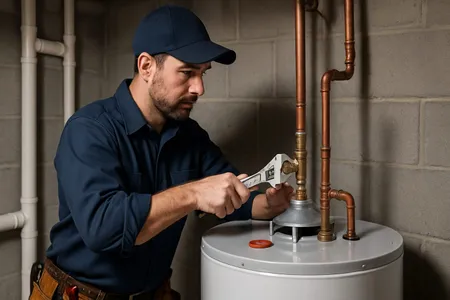
- Press the high-limit reset button. Kill the breaker, remove the upper access panel on the tank’s side, fold back the insulation, and find the red reset button on the upper thermostat (the ECO — energy cutoff). If it clicks when pressed, it was tripped. Restore power and give the tank 30–60 minutes.
- Understand what a trip means. The ECO trips because water exceeded a safe temperature — usually a stuck thermostat or a shorting element overheating the tank. One reset after a power flicker can be a fluke; a reset that trips again within days is a failing part telling you plainly. Repeated resetting without repair is how tanks end up boiling — don’t.
- Elements and thermostats. Two elements, two thermostats. Upper element dead = no hot water. Lower element dead = a little hot water that runs out fast. Testing takes a multimeter and the breaker off; replacement is an economical, common repair for a technician.
Gas Water Heater: No Hot Water
- Check the pilot light through the viewing window at the bottom. Out? Relight it following the printed instructions on the tank’s label exactly (typically: gas knob to PILOT, hold it down, click the igniter, keep holding 30–60 seconds, release, turn to ON).
- Pilot won’t stay lit? The classic culprit is the thermocouple — the safety sensor that holds the gas valve open only while it feels flame. A failing one shuts the pilot down seconds to minutes after you release the knob. Inexpensive part, common repair. On newer sealed-combustion heaters the equivalent is a flame sensor/igniter assembly — not owner-serviceable.
- Check the gas supply. Is the valve on the gas line to the heater open (handle parallel to the pipe)? Did other gas appliances stop working too? A recently exercised main valve or a utility interruption affects everything at once.
- Burner lights but water stays cold-ish? Thermostat setting first (see below), then suspect the gas control valve or heavy sediment insulating the burner’s heat from the water — a tank that rumbles and pops while heating is announcing its sediment layer. Flushing helps early; a tank that’s rumbled for years has likely lost real capacity and efficiency.
Tankless Water Heater: No Hot Water
- Read the display. Tankless units self-diagnose; the error code on the panel is the starting point, and the manual (or the manufacturer’s code list) maps it. Common fault families: ignition failure (gas supply), flame loss, exhaust/venting blockage, and scale.
- Check for a flow-rate issue. Tankless heaters need a minimum flow to fire — a barely-open tap may never trigger heating. Open the hot tap fully to test.
- The “cold water sandwich” — brief cold burst between hot uses — is normal tankless behavior, not a fault.
- Scale is the long-game killer in Central Texas hard water. A tankless unit here should be descaled (vinegar or descaler flushed through with a pump kit) roughly annually; declining temperature and flow are the symptoms. If yours has never been flushed and it’s throwing overheat or flow codes, that’s the likely story.
Lukewarm, Runs Out Fast, or Slow to Recover?
| Symptom | Likely Cause |
|---|---|
| Hot for one short shower, then cold | Failed lower element (electric); sediment displacing capacity (gas or electric) |
| Never quite hot | Thermostat set low — 120°F is the standard recommendation; verify before assuming a fault |
| Hot water turns cold fast at the tap | Broken dip tube letting cold inlet water short-circuit straight to the outlet |
| Fine in summer, marginal in winter | Normal — Texas groundwater arrives much colder in winter, so recovery slows; an aging heater shows it first |
| Household grew, heater didn’t | Undersizing — a capacity question, not a repair question |
Repair or Replace?
Tank water heaters last 8–12 years on average (full lifespan guide) — check yours by decoding the serial number (Rheem guide; the HVAC Age Decoder handles most brands). The honest lines:
- Under 8 years: thermocouples, elements, thermostats are all cheap relative to the tank’s remaining life. Repair.
- 8–12 years, major part failing: replacement conversation — especially if you’re already seeing rusty hot water or moisture at the base. See water heater costs.
- Any age, leaking from the tank itself (not a fitting): replace. A leaking tank is done; no repair exists.
- Considering the switch? Tankless vs. tank lays out the real trade-offs.
Deciding What’s Next
Use the diagnosis steps above to narrow down whether your issue is a quick fix or a sign your tank’s age makes replacement the smarter spend.
Helpful resources:
- Water Heater Cost Guide — replacement pricing before you need it
- How Long Does a Water Heater Last? — the age math
- Tankless vs. Tank — if you’re replacing anyway