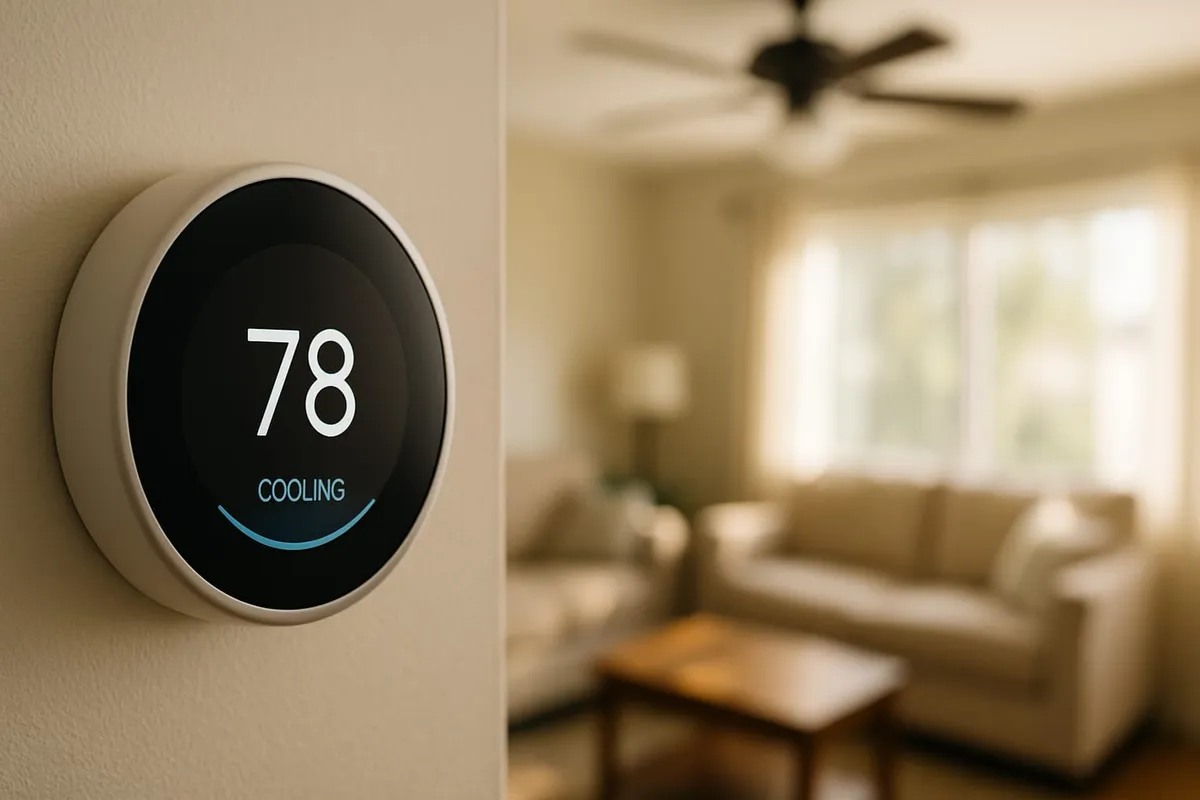
The Department of Energy’s recommended summer settings are 78°F when you’re home, 85°F when you’re away, and 82°F while sleeping — and in a Texas summer, each degree cooler than 78 costs you meaningfully on the bill, while each degree warmer saves. The honest part most guides skip: 78°F feels warm to many people, especially in a humid Central Texas August. The realistic goal is not obeying a number — it’s finding your highest comfortable setting and using ceiling fans, humidity control, and schedules to push that number up without suffering. (For the full season-by-season picture including winter, see What Temperature Should I Set My Thermostat To? — this page focuses on the Texas summer case and the heat-wave exception that guide doesn’t cover.)
The quick answer table
| Situation | DOE-recommended setting |
|---|---|
| Home and awake | 78°F |
| Away (work, errands) | 85°F |
| Sleeping | 82°F |
| Vacation (days away) | 85°F+ (not off — see below) |
Per the DOE, setting the thermostat back 7–10 degrees for 8 hours a day saves roughly 10% a year on heating and cooling. In a Central Texas home where the AC runs April through October, summer is where most of that saving lives.
Why does one degree matter so much in Texas?
Cooling cost scales with the gap between outside and inside temperature and with runtime — and a Texas AC is already running most of the day at peak. Nudging 74 to 78 shrinks the work on every one of those hours, which is why the small-sounding change shows up on the bill. It also cuts wear: fewer runtime hours is the quiet reason maintained systems in mild climates outlive Texas systems (more on lifespan).
How to make 78°F actually comfortable
- Ceiling fans, counterclockwise, in occupied rooms only. Moving air feels several degrees cooler on skin. A fan cools people, not rooms — turn it off when you leave. (Fan direction guide)
- Control humidity. Central Texas humidity is half of what makes 78 feel bad. A system that runs long, gentle cycles dehumidifies better than one short-cycling; if indoor humidity sits high, that is worth a service conversation before you surrender the thermostat.
- Block the west sun. Blackout curtains or solar screens on west-facing windows blunt the 3–7 p.m. load that makes afternoons miserable.
- Step up gradually. Go one degree a week. 74 → 78 overnight is a revolt; over a month it’s an adjustment most households don’t notice.
- Automate the schedule. A programmable or smart thermostat makes the away/sleep setbacks happen without willpower. (Smart thermostat installation cost)
The heat-wave exception (this matters)
On 103°F+ days, do not use a deep away-setback like 85°F and expect a quick recovery. A correctly sized AC gains only a few degrees per hour against extreme heat, and one sized-for-normal-days may hold an 18–20-degree gap at best. Coming home at 5 p.m. to a house set at 85 means hours of full-throttle runtime during peak electric rates — or a house that never gets there at all. During genuine heat waves, use a shallow setback (2–3 degrees) or none, and let the system run steady. If your AC can’t hold your setting at all on an extreme day, that is a capacity or maintenance question, not a thermostat one — see Why Is My AC Running but Not Cooling?
Should I turn the AC off when I leave?
In Texas, no — set it up, don’t shut it off. An off AC in a 100°F week lets the house and everything in it heat-soak into the 90s, humidity climbs unchecked (bad for wood, electronics, and mold risk), and the recovery run costs much of what “off” saved. The DOE-style setback (85°F away) captures most of the saving without the heat-soak. Same logic for vacations: 85°F, not off.
Frequently Asked Questions
Is 72°F too cold to set the AC in Texas summer?
It is not harmful — it is expensive. Holding 72 against a 100°F afternoon maximizes runtime and wear, and on extreme days many systems physically cannot hold a 28-degree gap, so they run continuously without ever satisfying. If you want 72, expect the bill that comes with it and make sure the system is maintained for the workload.
What temperature should I set at night in summer?
DOE guidance is 82°F while sleeping. Realistically, many people sleep better mid-to-upper 70s; a bedroom ceiling fan lets you raise the setting a couple of degrees at no comfort cost. Any setback above your daytime number still saves.
Does 78°F really save money over 72°F?
Yes — the DOE’s own guidance is that a 7–10-degree setback for 8 hours daily saves about 10% annually, and every degree of permanent increase reduces cooling load on every hour the system would have run. The exact dollars depend on your home, rates, and system; estimate yours with the Thermostat Savings Calculator.
Why does my house feel sticky at 78°F?
Humidity. If the air is cool but clammy, your system may be short-cycling (oversized or a maintenance issue) and not running long enough to dehumidify. That’s fixable — and fixing it is what makes 78 livable in Central Texas.
Bills climbing no matter what you set? Texas Temp Masters serves Killeen, Copperas Cove, Temple, Belton, and Harker Heights — a maintenance visit that restores lost efficiency often pays for itself in a Texas summer. Call (817) 704-0706 or contact us online, or check your setup against the Energy Savings Calculator.